
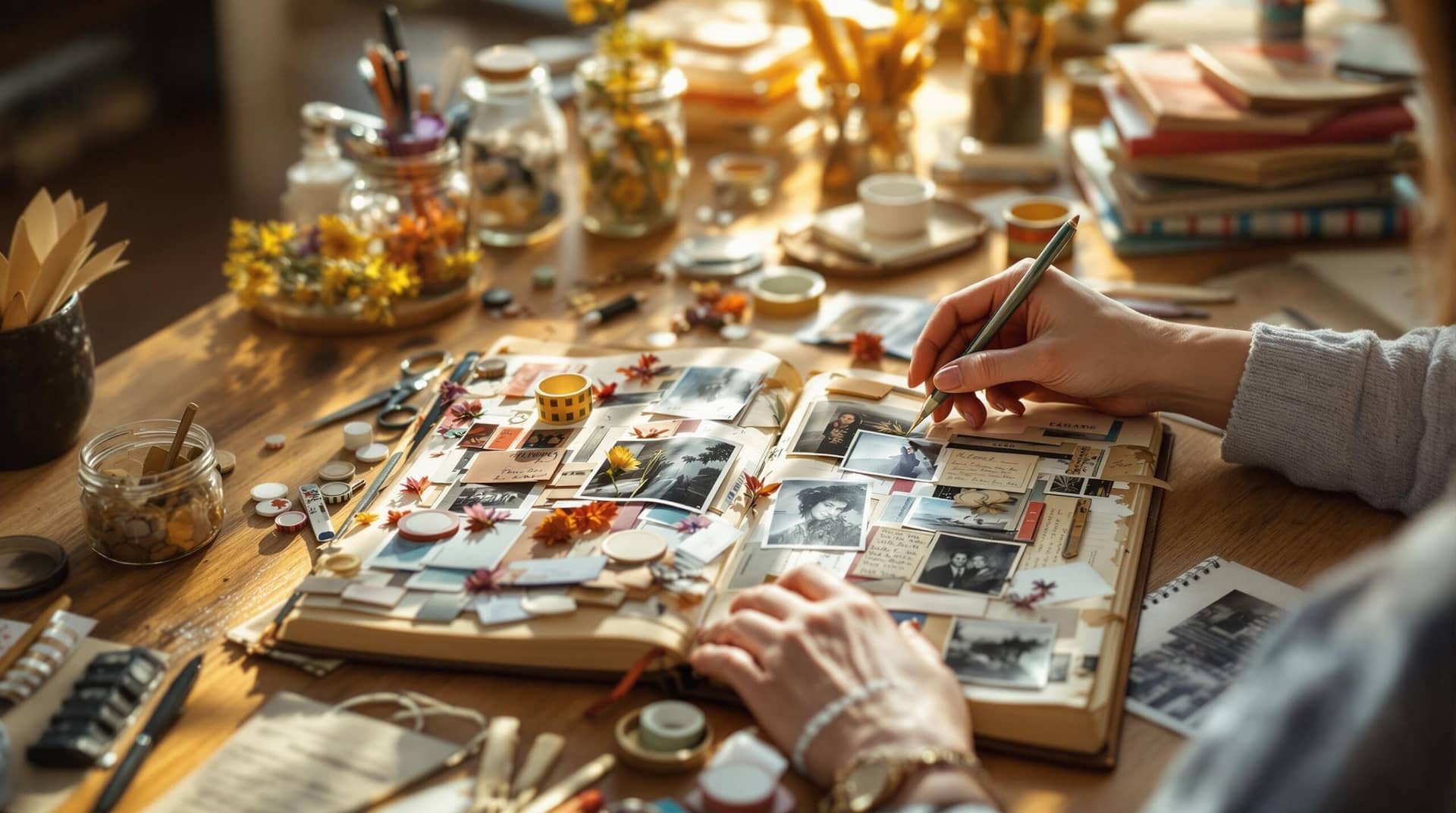
Traditional journaling intimidates millions who believe they’re “doing it wrong,” but junk journaling—transforming ticket stubs, fabric scraps, and packaging into layered visual stories—explicitly invites mess and experimentation over perfection. This creative practice combines collage, memory keeping, and reflection using recycled materials, offering an accessible entry point for self-awareness and emotional processing. Junk journaling is not scrapbooking with a new name. It is a reflective practice that uses images, textures, and words together to reveal patterns invisible in writing alone.
Related research on expressive writing and art therapy suggests that combining textures and words can reduce anxiety and depression symptoms, according to Women’s Mental Health Podcast. The sections that follow explore what junk journaling is, why combining images with words supports mental wellness, and how to start building your own memory mosaics without expensive supplies or artistic training.
Quick Answer: Junk journaling is a creative practice that transforms everyday ephemera—ticket stubs, packaging, fabric scraps, and old book pages—into layered visual journals that combine collage, writing, and reflection. Unlike traditional journaling, it eliminates perfectionism by treating materials as “junk” and pages as experiments in storytelling.
Definition: Junk journaling is a reflective practice that combines memory keeping, collage, and self-examination using recycled materials to create visual narratives supporting emotional processing and self-awareness.
Key Evidence: According to Women’s Mental Health Podcast, a 2020 randomized controlled trial found that expressive writing for 20 minutes per day, three days per week for six weeks significantly reduced depressive symptoms in adults with major depressive disorder.
Context: While research hasn’t studied junk journaling specifically, combining visual elements with reflective writing may enhance these therapeutic benefits through multiple channels of emotional expression.
Junk journaling works because it externalizes internal experience through both images and words, reducing the cognitive load of processing emotions through text alone. When you layer ticket stubs with handwritten reflections, you create multiple entry points to memory and feeling. The benefit comes from accumulation over time, not from any single perfect page. What follows walks you through exactly what makes this practice different, how it supports mental wellness, and how to start building pages that reveal patterns you can work with.
Key Takeaways
- No artistic skill required: Junk journaling uses recycled materials and celebrates imperfection, making it accessible to anyone intimidated by traditional creative practices.
- Dual-channel processing: Combining images, textures, and words provides multiple ways to access emotions that may be difficult to name or write about directly.
- Measurable mental health support: Art therapy studies show associations with reduced anxiety and depression, according to Women’s Mental Health Podcast.
- Sustainable memory keeping: The practice transforms everyday items from trash to story while supporting mindful consumption.
- Personalized storytelling: Pages can be purely visual, text-heavy, or anywhere in between. What matters is meaning for the maker.
What Is Junk Journaling and Why It Works
Maybe you’ve started journals before that now sit half-empty on a shelf. That’s more common than you’d think. What stops most people isn’t lack of discipline but the pressure to do it perfectly, to write something profound every time, to maintain pristine pages. Junk journaling removes that pressure by design.
Junk journaling combines memory keeping, collage, and reflection using recycled materials like envelopes, fabric scraps, magazine pages, and packaging. Materials are considered “junk” and pages are expected to be messy or experimental, which lowers perfectionism and fear of “ruining” a notebook, according to Virta Health. This finding matters especially for people who’ve tried journaling before and stopped because they felt they were “doing it wrong.” The practice explicitly invites experimentation over correctness.
“Junk journaling empowers you to express yourself creatively without the pressure of perfection,” according to Women’s Mental Health Podcast. Contemporary practice emerged in the 2010s through YouTube tutorials and Instagram hashtags, growing out of scrapbooking and altered books communities, as noted by Joyful Art Journaling. Historical roots run deeper: commonplace books, scrapbooks, and memory albums have preserved ephemera for centuries. What shifted was access, community, and the deliberate embrace of imperfection.
The practice exists at the intersection of art journaling, scrapbooking, bullet journaling aesthetics, and therapeutic journaling within trauma recovery and grief work. Research by Painted Kat points to a 2021 cross-sectional study that found people who regularly engaged in crafts like papercraft or mixed-media art reported higher levels of relaxation and positive affect, with researchers pointing to “flow” and mindful attention as mechanisms. This research helps explain why the hands-on, repetitive aspects of junk journaling can feel calming and grounding, especially when emotions run high.

The Dual-Channel Advantage
Combining words and images provides multiple access points to internal experiences. When feelings are hard to name, texture, color, and arrangement can carry meaning before you’re ready for sentences. A 2015 study of visual journaling in college students reported decreased stress and increased emotional awareness after several weeks of guided sessions. This explains why pairing prompts with collage provides pathways to notice what’s happening beneath the surface.
You might find yourself choosing dark, torn edges when writing about loss, or layering translucent papers when exploring confusion. The materials themselves become part of the language. Notice how your hands reach for certain colors or textures without conscious thought. That instinct carries information worth paying attention to.
The Mental Wellness Connection
Health platforms now present junk journaling alongside meditation and gratitude journaling as a tool for stress relief, mindfulness, and emotional wellbeing, according to Virta Health. Practitioners describe junk journaling as combining “the therapeutic benefits of journaling with the creative freedom of crafting,” positioning it as a tool for self-expression, reflection, and healing, according to Women’s Mental Health Podcast.
Evidence from related practices supports this framing. A 2017 systematic review of art therapy for adults with mental health conditions found associations with reduced anxiety and depression and improved quality of life, according to Women’s Mental Health Podcast. These findings suggest that combining images, color, and words to process experiences (core to junk journaling) may help with emotional regulation and insight.
Junk journaling works through three mechanisms: it externalizes feelings through visual language, it creates tangible records you can revisit, and it engages your hands in repetitive, soothing motion. That combination reduces rumination and increases choice in how you respond to difficult emotions. The hands-on, repetitive aspects of cutting, arranging, and gluing can feel calming and grounding when emotions run high. There’s something about the rhythm of scissors through paper, the slow deliberation of placement, the tactile satisfaction of smoothing glue that pulls you back into your body when your mind is spinning.
The practice is particularly valuable for people in therapy, recovery, or personal growth work who need permission to explore without judgment. Many therapists and coaches have begun integrating art journaling or junk journaling into their work as a tool for processing experiences and noticing emotional patterns, though this is rarely documented in formal research. The practice is prevalent in communities focused on trauma recovery, eating disorder recovery, and grief, where people create timelines or “memory books” out of ephemera and writing, externalizing internal narratives in safer ways than diving straight into paragraphs of prose.
An important caution: this is a tool, not a replacement for professional support. People with trauma histories should build grounding skills first and work with therapists when exploring overwhelming memories. If you notice yourself avoiding your journal, especially when entries start feeling like evidence of failure rather than understanding, that avoidance is information, not weakness.
How to Start Building Your Memory Mosaics
You don’t need expensive supplies, artistic skill, or a clear vision to begin junk journaling. Start with a cereal box, old envelopes, and a glue stick. The practice has “no rules…anything goes,” which matters especially for people intimidated by blank pages or convinced there’s a “right way” to journal, according to Virta Health.
Look around your home right now. You probably have ticket stubs from movies or concerts, receipts tucked in drawers, greeting cards you couldn’t throw away, fabric scraps from old projects, magazine pages with images that caught your eye. These are your materials. The journal base itself can be an old book with interesting pages, a stack of envelopes sewn together, or a simple notebook. What matters is that you start exactly where you are.
Five Approaches That Support Self-Understanding
Layered storytelling uses tickets, photos, receipts, scraps of fabric, and short written reflections to tell the story of a day, relationship, or season, according to Painted Kat. Notice what you choose to include. Those choices reveal something. Are you saving concert stubs but not doctor’s appointment receipts? Holding onto gift tags but discarding receipts from solo meals? Over time, patterns emerge in what you preserve and what you let go.
Prompt-based pages pair reflection questions like “A moment I keep replaying” or “What this season taught me” with images, colors, and textures that feel like the experience you’re exploring. This gives you multiple channels to access feelings when words alone feel stuck. You might layer a page about anxiety with torn edges and overlapping text, or create a page about hope using translucent papers and open spaces. The visual choices become part of the reflection itself.
Pattern noticing becomes easier when you build repeating structures: monthly spreads, color-coded moods, recurring motifs like doors or keys or birds. These structures let you flip back and see what tends to show up. Do energy levels crash every February? Does a specific person’s name appear in anxious pages but rarely in joyful ones? Pattern recognition is one of the core gifts of any sustained reflective practice. For more ideas on visual reflection, explore creative gratitude journaling using art and photos.
Externalizing inner stories through collage helps when experiences feel too big or tangled to write about directly. People working with grief or trauma sometimes find it easier to represent what happened through symbolic imagery (an empty chair, a locked box, a horizon line) before they’re ready for sentences. This isn’t avoidance. It’s a gentler way in, one that respects your readiness.
Regulation and grounding happen almost as side effects. The sensory, repetitive work of cutting, arranging, and gluing can calm your nervous system when emotions feel intense. Focusing on texture, color, and placement brings you back into your body and the present moment. When everything feels overwhelming, the simple act of choosing which scrap goes where can anchor you.
Common mistakes to avoid: Don’t spend so much time trying to make pages Instagram-worthy that you skip reflection entirely. Resist comparing your pages to others. Decoration can be part of the process, but if you’re only decorating and never pausing to notice what comes up, the self-understanding piece gets lost. Your journal is for you: messy, half-finished, weird, private. That’s exactly what it should be. And if you miss a week, or a month, your journal will still be there when you come back. For more inspiration on working with everyday materials, see the creative magic of junk journaling.
Where Junk Journaling Is Headed
Rising integration with wellness and mental health messaging positions junk journaling alongside evidence-supported practices. Platforms focused on chronic illness management, anxiety relief, and trauma recovery increasingly include junk journaling in their toolkits, according to Virta Health. This frames the practice as part of a broader self-care approach rather than isolated hobby.
Alignment with sustainable and slow-living movements grows stronger. Emphasis on reusing materials and creating with your hands fits into cultural shifts away from fast consumption and constant digital engagement, according to Painted Kat. People describe junk journaling as a “digital detox” practice, something that pulls you out of scrolling and into noticing the texture of paper, the smell of old book pages, the rhythm of cutting and gluing.
Content is shifting too. Early tutorials focused on techniques and aesthetics: how to make pockets, how to layer ephemera, how to achieve a certain vintage look. More recent mental-health-focused content centers prompts, reflection questions, and emotional themes. The question is shifting from “How do I make this look good?” to “What does this page help me see or understand?” That shift matters. It repositions the practice from performance to process. To explore how everyday objects carry meaning, see finding meaning in everyday objects.
A knowledge gap remains: no large, direct studies on junk journaling as a distinct intervention exist in peer-reviewed research. Most evidence comes from extrapolating related findings on expressive writing and art therapy. The practice could benefit from formal research given existing evidence, but remains in a curious position: widely practiced, experientially valued, largely undocumented in academic terms. Researchers interested in creative coping could design studies comparing junk journaling protocols to writing-only approaches, but such trials aren’t yet visible in the literature.
Frequently Asked Questions
What is junk journaling?
Junk journaling is a creative practice that transforms everyday ephemera—ticket stubs, packaging, fabric scraps, and old book pages—into layered visual journals combining collage, writing, and reflection using recycled materials.
How is junk journaling different from scrapbooking?
Unlike scrapbooking which focuses on preserving memories in polished layouts, junk journaling is a reflective practice that embraces mess and experimentation, using “junk” materials to create meaning rather than perfection.
What supplies do I need to start junk journaling?
You can start with basic household items: a cereal box or old book for the base, ticket stubs, receipts, fabric scraps, magazine pages, envelopes, and a simple glue stick. No expensive supplies or artistic training required.
Can junk journaling help with mental health?
Research on related practices shows art therapy can reduce anxiety and depression symptoms. Junk journaling combines visual elements with reflective writing, providing multiple channels for emotional processing and self-awareness.
What does dual-channel processing mean in junk journaling?
Dual-channel processing means using both images and words to access emotions. When feelings are hard to name, texture, color, and arrangement can carry meaning before you’re ready to write sentences about experiences.
How often should I work in my junk journal?
There’s no required frequency for junk journaling. The practice eliminates perfectionism by design—if you miss weeks or months, your journal will be there when you return. Consistency matters less than authentic engagement.
Sources
- Painted Kat – Creative practice perspectives on junk journaling as memory keeping, mindfulness tool, and sustainable craft
- Virta Health – Accessible introduction framing junk journaling as low-pressure self-expression for people managing chronic conditions
- Women’s Mental Health Podcast – Mental health applications, therapeutic benefits, research on expressive writing and art therapy
- Love Paper – Overview of junk journaling’s rise, stress reduction claims, sustainability emphasis
- Joyful Art Journaling – Definition, history, benefits including artistic experimentation and self-reflection
- YouTube – Junk Journaling Tutorial – Visual demonstration of techniques and creative approaches
