
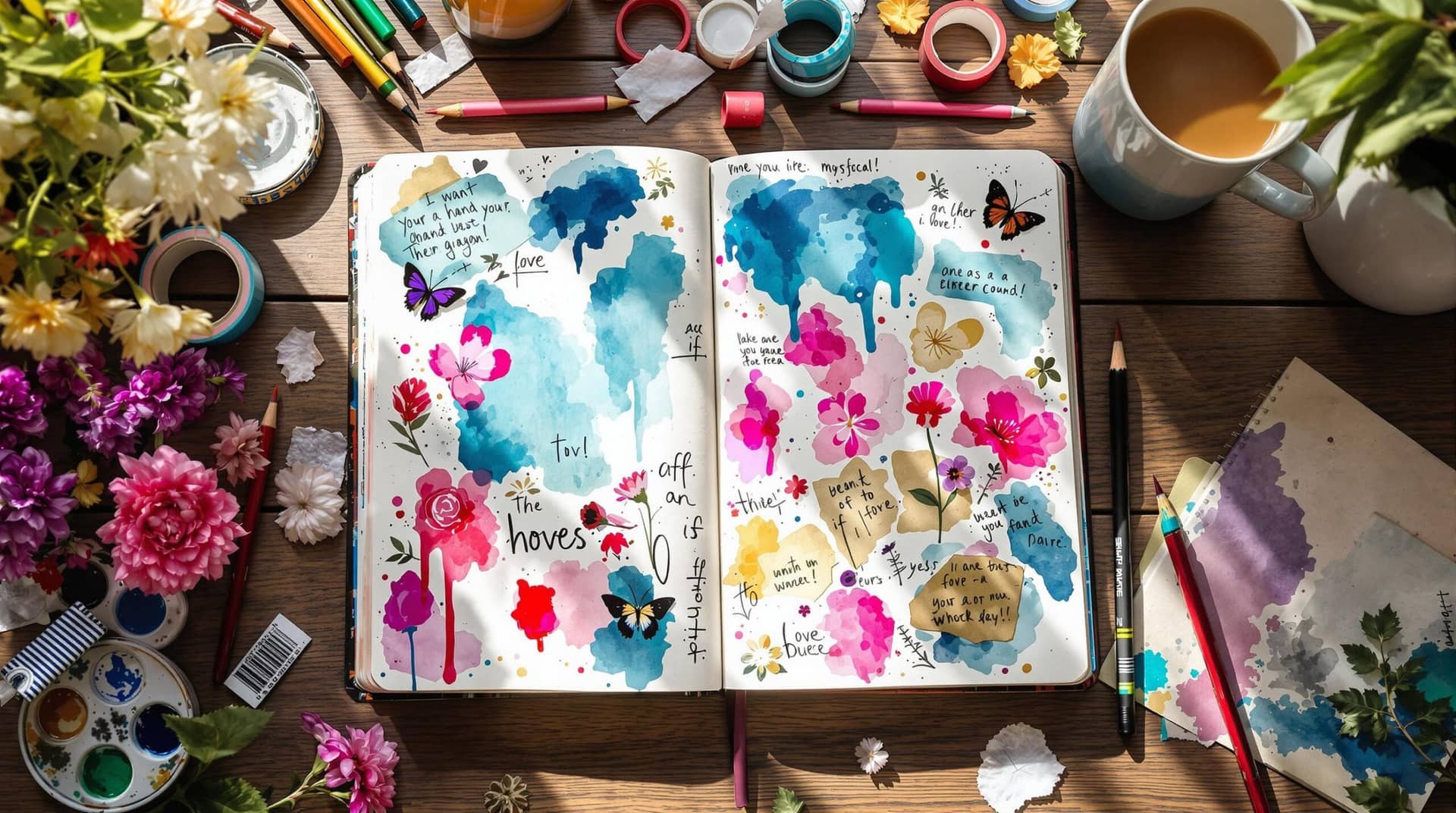
Maybe you’ve opened a blank journal, pen in hand, only to close it again because the pressure to write something meaningful felt overwhelming. Art journaling offers a different entry point—one that removes the demand for perfect sentences or polished artwork. By combining visual elements like paint swatches, collage, and spontaneous mark-making with reflective writing, you create multiple ways to explore emotions and thought patterns. Art journaling is not traditional diary-keeping with illustrations added. It is structured observation through intuitive visual expression that builds self-awareness over time.
Quick Answer: Art journaling ideas combine visual creativity with reflective writing through accessible techniques like mood mandalas, painted backgrounds, collage layering, and emotion pages, allowing you to explore feelings and patterns without artistic skill or perfect execution.
Definition: Art journaling is a reflective practice that integrates drawing, painting, collage, and mixed media with written observation to explore emotions and thought patterns through intuitive visual expression.
Key Evidence: According to Artful Haven, art journaling integrates drawing, painting, and collage with written reflection, allowing beginners to start with color swatches or background layers before adding focused elements, reducing the intimidation of empty pages.
Context: This approach positions mistakes as natural elements of discovery rather than failures, making it particularly valuable for those who’ve stopped journaling before due to perfectionism.
The practice works through three mechanisms: it externalizes internal experience onto a visible surface, it creates entry points through color and image when words feel inaccessible, and it accumulates observations over time that reveal patterns invisible in isolated moments. When you paint a background before knowing what the page will explore, you bypass the paralysis of “what should I write about?” Visual elements become anchors that words alone might not offer. The sections that follow will walk you through specific art journaling ideas that work for beginners, common mistakes to avoid, and how the practice builds self-awareness through consistent, compassionate observation.
Key Takeaways
- Visual backgrounds ease anxiety by removing blank page pressure before you know what the page will explore
- Mood mandalas build emotional vocabulary through colors and shapes that represent feelings difficult to articulate in words, as noted by Day One App
- Mixed media encourages experimentation by transforming mistakes into creative discovery through layering paint, ephemera, and text
- Themed approaches provide flexible structure with emotion dictionaries and gratitude pages that support consistency without rigid daily commitment
- Accessible materials lower barriers since basic supplies like markers, watercolors, and magazine clippings are sufficient to start, according to The Social Easel Online Paint Studio
What Makes Art Journaling Different from Traditional Journaling
You might notice that when emotions feel tangled or unclear, finding the right words becomes its own obstacle. Art journaling combines visual elements (painting, drawing, collage, and mixed media) with written reflection, creating multiple entry points for self-exploration beyond linear writing. The practice centers on what emerges during the creative process rather than on artistic skill or producing polished work. A mood becomes overlapping color swatches rather than a paragraph struggling to describe feelings.
Research by Artful Haven emphasizes that there’s no right or wrong way to art journal, encouraging practitioners to embrace imperfections and let go of expectations. Your art journal is a judgment-free zone where you can freely express yourself. This matters because the biggest barrier most people face isn’t lack of artistic ability but fear of doing it wrong.
Materials typically include paints, markers, colored pencils, glue sticks, magazine cutouts, photographs, ticket stubs, and found ephemera layered onto journal pages, according to TinkerLab. The process emphasizes experimentation and pattern recognition over time, allowing you to notice what colors, images, or themes repeatedly surface across multiple entries. Abstract expression (chaotic scribbles for anxiety, rounded forms for contentment) bypasses the need for precise language when emotions feel complex or unclear.

Why Visual Expression Supports Emotional Exploration
Creating visual representations of feelings activates different cognitive processes than verbal description alone. Layering multiple media creates texture and depth that mirrors how emotions actually feel: messy, overlapping, and multi-dimensional rather than linear. This embodied approach meets you where words might fail. When you look back at a page created during a difficult week, the visual elements often communicate what you couldn’t articulate at the time.
Essential Art Journaling Ideas for Beginners
Starting with backgrounds addresses the most common barrier: blank page intimidation. Paint random watercolor washes, create color swatches in hues that attract you today, or use markers to add loose gestural marks across the page without knowing what the page will ultimately explore. Artful Haven recommends this approach because once the page has visual presence, you can add focal elements like photographs, drawn images, or glued text, then journal around them with written reflections about what surfaces.
Mood mandalas create visual vocabulary for emotional tracking. Draw a circle and fill it with colors, shapes, and symbols representing your current emotional state, as described by Day One App. Notice patterns over time: anxiety might consistently appear as sharp angles in dark blues, while contentment shows up in rounded forms with warm yellows. Add small written notes around the mandala describing physical sensations or thoughts accompanying the feeling. Over weeks or months, you develop fluency in your own symbolic language.
Emotion pages allow deep exploration of specific feelings without judgment. Dedicate individual pages to single emotions you want to understand better (loneliness, joy, frustration, hope). Mindful Art Studio suggests representing the emotion through textures, colors, and metaphorical images: anger as layered red paint scraped to reveal black beneath, with torn paper edges and associated words or phrases. Finish with written observations about when this emotion tends to surface for you.
Collage approaches support memory work and narrative exploration. Layer photographs, ticket stubs, receipts, or found magazine images with written annotations to explore what emerges around specific memories. You might discover you consistently remember sensory details but rarely note emotions, or that certain relationships appear in your memory work with particular visual themes. These observations arrive without forcing analysis.
Mind mapping reveals thought patterns and connections. Place a central theme (a recurring thought, relationship dynamic, or decision) in the middle of your page and draw branches outward representing connected ideas, as suggested by Day One App. Use different colors for different types of connections and let arrows show relationships between elements. This visual mapping often shows how certain fears always connect to specific people or particular hopes link to childhood experiences.
Quick Prompts When Time Feels Limited
“Doodle your current mood” needs only five minutes and basic markers. “Paint three color swatches that match how you’re feeling” creates entry points without extensive planning. “Glue one found image and write three words about why it caught your attention” combines visual and verbal reflection in brief sessions. Consistent brief engagement often serves self-understanding better than waiting for large time blocks. These micro-practices honor where your energy actually is.
Common Mistakes to Avoid in Art Journaling Practice
Waiting for artistic skill or “good” drawing ability before starting prevents many people from beginning the practice entirely. Art journaling values abstract expression and symbolic representation over realistic rendering. Emotions don’t need to look like recognizable objects. The practice works through the reflective process of noticing what surfaces, not through producing aesthetically impressive pages. If you can hold a marker or brush, you have sufficient skill to explore what comes up for you.
Treating your art journal like something others will evaluate undermines its value as a private space for self-discovery. This isn’t a performance or portfolio. It’s a judgment-free zone where you explore what emerges without concern for external opinions. Perfectionism carries over from traditional journaling attempts, causing practitioners to rip out pages they deem “failures” or avoid the journal when feeling uninspired. TinkerLab emphasizes that mistakes become part of the creative process rather than obstacles, with focus on intuitive play over representational accuracy.
A pattern that shows up often looks like this: someone buys a beautiful blank journal and expensive art supplies, then feels too intimidated to “mess them up” with imperfect work. The journal sits unused for months. Begin with what’s available (basic markers, watercolors, glue sticks, and magazine clippings) rather than waiting for the perfect setup, according to The Social Easel Online Paint Studio. The practice centers on the reflective process rather than specialized equipment.
Forcing daily commitment when energy doesn’t naturally flow creates pressure that defeats the purpose. Themed approaches like emotion dictionaries or gratitude pages provide structure that supports consistency without rigid daily requirements, as noted by Mindful Art Studio. Working only when you feel drawn to the practice often yields more genuine insights than obligatory daily entries. If you miss a week or a month, your journal will still be there when you come back. There’s no “falling behind” in a practice designed for self-discovery.
How Art Journaling Builds Self-Awareness Over Time
Pattern recognition emerges through consistent practice as you notice what colors, images, themes, and emotions repeatedly appear across multiple entries. Visual vocabulary develops organically. You begin recognizing that certain color combinations or compositional choices signal specific emotional states or thought patterns. Creating mood mandalas over weeks or months reveals that emotions manifest with consistent visual characteristics: perhaps sadness always includes downward-flowing elements while hope appears with upward movement.
Collage memory work uncovers hidden narratives by externalizing memories in ways that invite compassionate observation rather than linear storytelling. Layering photographs, ticket stubs, and found text with annotations helps you explore what surfaces around past moments, often revealing patterns in how you frame experiences, as described by Day One App. Notice what elements you’re drawn to include and what patterns appear in how you frame past experiences. These observations arrive without forcing analysis.
Non-judgmental observation of your own creative process provides metacognitive benefits. Rather than evaluating whether pages are “good” or whether you’re “doing it right,” the practice encourages noticing what tends to appear in your work, what feelings arise during creation, and what patterns you observe over time. This reflection on the reflection itself deepens self-understanding beyond what the individual pages reveal. You learn not just about the emotions you’re exploring but about how you tend to approach emotional exploration.
Mind mapping specific themes (recurring decisions, relationship dynamics, fears) shows spatial relationships between thoughts that linear writing might not expose. The practice establishes visual vocabulary for feelings that might be difficult to articulate in words alone, allowing you to notice what tends to surface across multiple entries, according to Day One App. Over time, you develop fluency in your own symbolic language, recognizing what certain images or color choices mean in your personal context.
For more on capturing internal experience, explore what is thought journaling. If you’re drawn to combining gratitude practice with visual expression, see visual gratitude journaling examples. For deeper exploration of narrative through images, read about creating visual stories through artistic journaling.
Why Art Journaling Ideas Matter
Art journaling ideas matter because they offer entry points when words feel impossible. The practice creates distance between stimulus and response through the act of externalizing internal experience onto a page. That distance is where choice lives. Over time, patterns that once controlled you become patterns you can work with, not because you’ve analyzed them to death but because you’ve made them visible through consistent, compassionate observation.
Conclusion
Art journaling ideas transform everyday thoughts into creative expressions by offering accessible techniques that bypass the perfectionism and blank page anxiety that stop many people from maintaining reflective practices. Whether you start with simple painted backgrounds, create mood mandalas to track emotional patterns, or layer collage elements to explore memories, the practice centers on noticing what surfaces rather than producing polished artwork. Begin with materials you already have and themes that draw your attention, trusting that patterns will emerge through consistent, compassionate observation of what your creative process reveals. The pages won’t judge you. They’ll simply hold what you need to see.
Frequently Asked Questions
What is art journaling?
Art journaling is a reflective practice that combines visual elements like painting, drawing, and collage with written reflection to explore emotions and thought patterns through intuitive creative expression rather than perfect artwork.
What materials do I need to start art journaling?
Basic supplies like markers, watercolors, glue sticks, and magazine clippings are sufficient to start. You don’t need expensive art supplies—the practice centers on reflection, not specialized equipment.
How is art journaling different from regular journaling?
Art journaling creates multiple entry points for self-exploration beyond linear writing by combining visual elements with text, allowing you to express feelings through color and imagery when words feel inaccessible.
What are mood mandalas in art journaling?
Mood mandalas are circles filled with colors, shapes, and symbols representing your current emotional state. They help build visual vocabulary for tracking feelings and reveal patterns over time in your emotional landscape.
Do I need artistic skill to start art journaling?
No artistic skill is required. Art journaling values abstract expression and symbolic representation over realistic drawing. If you can hold a marker or brush, you have sufficient ability to explore your thoughts and feelings.
How does art journaling build self-awareness?
Through consistent practice, you notice recurring colors, images, and themes across entries, developing visual vocabulary for emotions and recognizing patterns in how you process experiences and feelings over time.
Sources
- Day One App – Comprehensive guide to art journaling methods including mood mandalas, mind mapping, and collage approaches for emotional exploration
- TinkerLab – Beginner-focused resource offering themed prompts, mixed media techniques, and starter ideas for establishing creative journaling practice
- Artful Haven – Practical guidance on overcoming blank page anxiety through background creation and accessible entry points for new practitioners
- The Social Easel Online Paint Studio – Introduction to materials and supplies for art journaling with emphasis on using available resources
- Mindful Art Studio – Connection between art journaling and mindful self-reflection, featuring emotion-focused techniques and pattern observation strategies
