
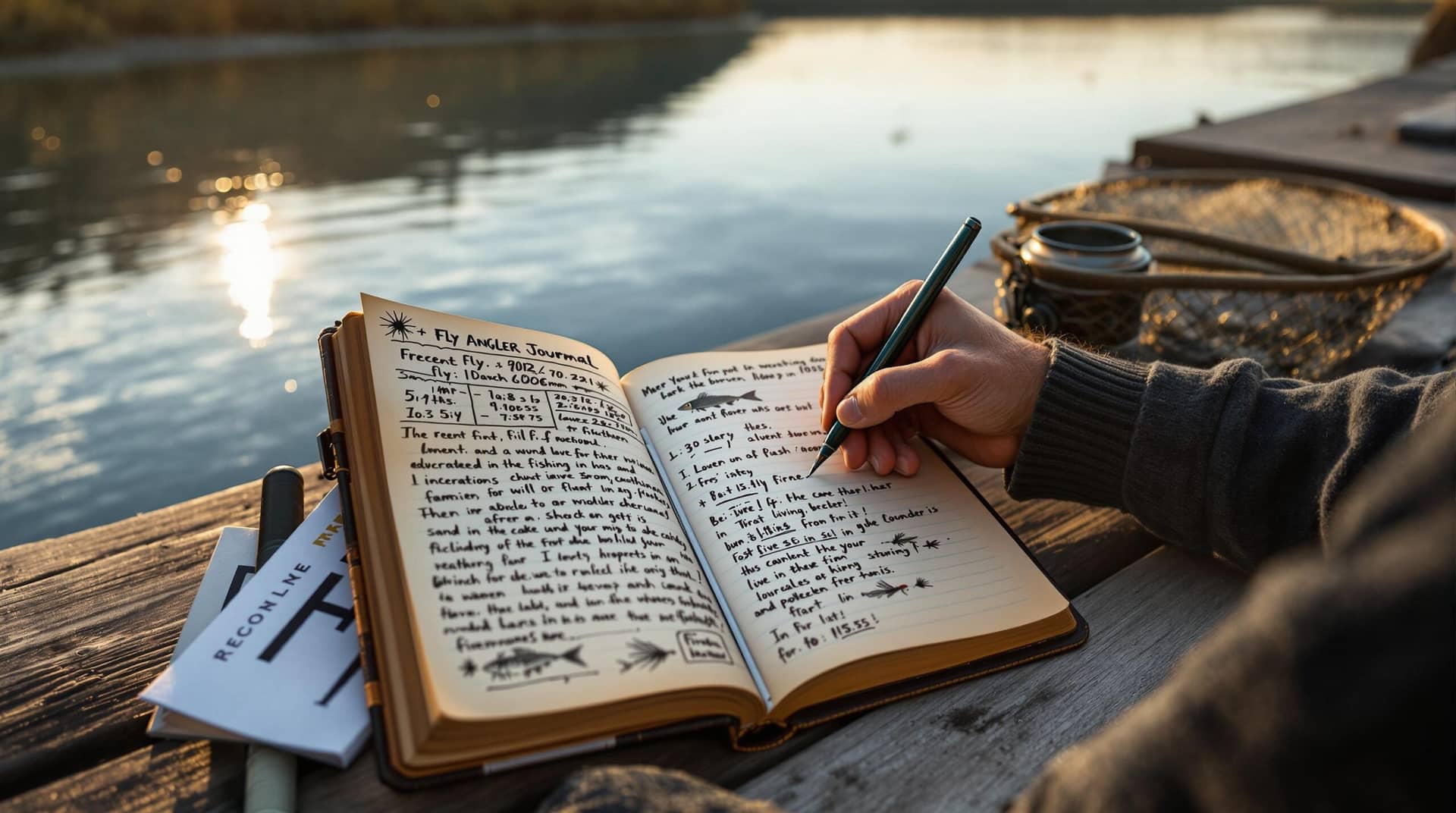
Write seven things down after every trip: when and how long, where, the air, the water, what you caught, what you threw, and one line on what you would change. If you will never fill a table, keep five: date and hours, spot, tide stage or river level, one water observation, and what worked or blanked. A season of those entries, sorted by spot at the end of the year, gives you one rule per spot in the form "spot, condition, what to throw". The two published examples on this page were both built from fields in that minimum.
The clearest account of what a log can find is a surf angler's in On The Water: his entries showed he had "never, ever, caught a fish on a waning moon" at one of his spots, and that another spot had "an extremely small, 15-minute window that produces my best fish every moon, every month, every year." He says he would have missed both without the written record. In The Art of Journaling, chapter 12, the symptom log I teach pairs a number with the weather, diet and activity around it, because a number alone cannot be compared; a fishing log is that idea with fish in it.
Quick Answer: Log seven fields at the car before you drive off: date and hours, spot, air (temperature, wind direction and speed, cloud), water (temperature, clarity, tide stage or river level), target and catch with size and count, lure or bait with colour, depth and retrieve, and one line on what you would do differently. Blank trips get logged the same way. At season's end, sort by spot and write one rule per spot.
Definition: A fishing journal, or fishing log, is a dated record of each trip's conditions, tackle and results kept so that entries can be compared across a season.
Key Evidence: Kevin Cochran, a Texas coastal guide, kept a log of every trip from late 1990 to early 2002 and writes in Texas Saltwater Fishing Magazine that recording where an effort was made without result "can be the most useful information of all in the end", and that anglers who fail to note "key positive decisions" are less likely to repeat them.
Context: Both anglers say the log works only when the same fields are recorded every time, in the same words, so that trips can be set side by side.
Key Takeaways
- Seven fields, written at the car, every trip. Blanks included: Cochran calls the unproductive spots the most useful information of all.
- Name lures, presentations and spots the same way every time; a log with "the point" in June and "north rocks" in August cannot be sorted.
- Five fields are the floor: date and hours, spot, tide or level, one water observation, worked or blanked.
- Thirty minutes at season's end: sort by spot, mark the entries that produced fish, and write one rule per spot.
- If the log has become homework, drop the reflection line and keep the numbers.
The one-trip log template
| Field | Example value | Why it matters |
|---|---|---|
| Date and hours | 14 Jun, 05:30 to 08:15 | Which hours produce at each spot |
| Spot | South jetty, outer rocks (or a GPS mark) | The key you will sort by at season's end |
| Air | 12C, SW 10 to 15, overcast | Cochran's minimum weather record |
| Water | Clear, 2 hours before high, 15C | Tide stage or river level is the field most patterns turn on |
| Target and caught | Bass; 2 landed, 48cm and 41cm, 1 dropped | Count everything, including fish you released |
| Lure or bait | Soft plastic, white, 14g, slow along the bottom | Same words each time, or it cannot be sorted |
| One line | Fish came as the light went; start 30 minutes earlier | Read this before the next trip |
The same lines for a phone note:
Date/hours:
Spot:
Air (temp, wind, cloud):
Water (temp, clarity, tide/level):
Target/caught (size, count):
Lure/bait (colour, depth, retrieve):
Would change:
The five-field minimum
If the table is more than you will keep, log five things: date and hours, spot, tide stage or river level, one water observation, and whether what you threw worked or blanked. The waning-moon finding needed a date and a spot; the 15-minute window needed a date, a spot and the hours. Cochran's point about unproductive spots needs a spot and the word "blank". Everything past the five fields sharpens the rule.
An illustrative month
Five entries, invented for the page, one river spot and one shore spot.
| Date, hours | Spot | Tide or level | Water | Worked or blanked |
|---|---|---|---|---|
| 2 Jun, 05:30 to 08:00 | South jetty | 2 hrs before high | Clear | White soft plastic, 2 bass |
| 9 Jun, 06:00 to 09:00 | Mill pool | Level low | Clear | Blanked on nymphs |
| 15 Jun, 12:00 to 15:00 | South jetty | 1 hr after high | Coloured after rain | Blanked, plastics and metal |
| 22 Jun, 05:00 to 07:30 | South jetty | 2 hrs before high | Clear | White soft plastic, 3 bass |
| 28 Jun, 19:00 to 21:00 | Mill pool | Level up after rain | Slightly coloured | Dry fly at dusk, 4 trout |
The three-line review from those five: South jetty produces on the flood, early, in clear water, and blanked on the ebb after rain. Mill pool blanked low and clear in the morning and fished at dusk with the level up. Nothing on wind, because it was not logged; add it in July.
Paper or phone
| Paper notebook | Phone note or app | |
|---|---|---|
| At the water | Works wet, no battery, room for a sketch of the bank | Faster to type, GPS mark and photo in one place |
| At season's end | Sorting by spot means reading every page | Search and sort in seconds |
| Best fit | Fewer than 20 trips a year | More than 20, or more than three spots |
Cochran kept his log by hand for over eleven years and says a fuller log beats a cryptic one. The site's hybrid paper-and-app system covers the case where the numbers go in the phone and the sketches stay on paper.
The season review
Thirty minutes at the end of the season.
- Sort every entry by spot.
- Mark each entry that produced fish.
- For the marked entries only, list the tide stage or level and the water temperature or clarity.
- Write one rule per spot in the form "spot, condition, what to throw": for the month above, "South jetty, flood, first light, clear water, white plastic slow."
- Read the blanks for each spot and add a second line if they share a condition: "South jetty, ebb after rain, do not bother."
The rule is the starting point for next season's first trip at that spot, and next season's entries confirm or replace it. Cochran describes the same step as cross-referencing tide level with success in each area until "a clearer picture" emerges.
When the log stops working
- Short trips: log the five fields only, in under a minute.
- Trips with friends: log at the car once you are off the water, and record how many rods fished; Cochran notes that one angler catching twelve fish differs from four anglers catching twelve.
- Fly fishing: add a fly-pattern field and drop retrieve; on a river, the level replaces the tide stage.
- The log has become homework: skip the reflection line for a month and keep the numbers. The review works on numbers alone.
- Entries you cannot sort: pick one name per spot, lure and presentation and keep it; Cochran's advice is to name presentations and use the names over time.
Why a fishing journal matters
Memory keeps the best fish and drops the conditions around it, and Cochran's phrase for what it leaves you with is "fuzzy memory, which tends to exaggerate successes and failures". A log keeps the conditions. The payoff is one rule per spot, and the rule only comes from setting a season of trips side by side, blanks included. It costs a minute at the car and half an hour in the autumn, and it is the only way to learn that a spot has never produced on a waning moon.
Related reading
- A Hybrid Journaling System: What Goes on Paper, What Goes in the App
- Digital vs Paper Journaling: Choosing a Format
- Task Management Journal: Daily Tasks, Time Blocking and Weekly Reviews
- How-To Guides
Sources
- On The Water, Reasons to Keep a Fishing Log – A surf angler's account of two patterns found only through his log: no fish on a waning moon at one spot, and a 15-minute window at another
- Kevin Cochran, Texas Saltwater Fishing Magazine – A guide's log kept from 1990 to 2002: the fields to record (date, time, every location tried, angler count, all fish, lures by name and colour, named presentations, temperature, wind, cloud, moon, tide level), why blanks are the most useful entries, and the value of key positive decisions