
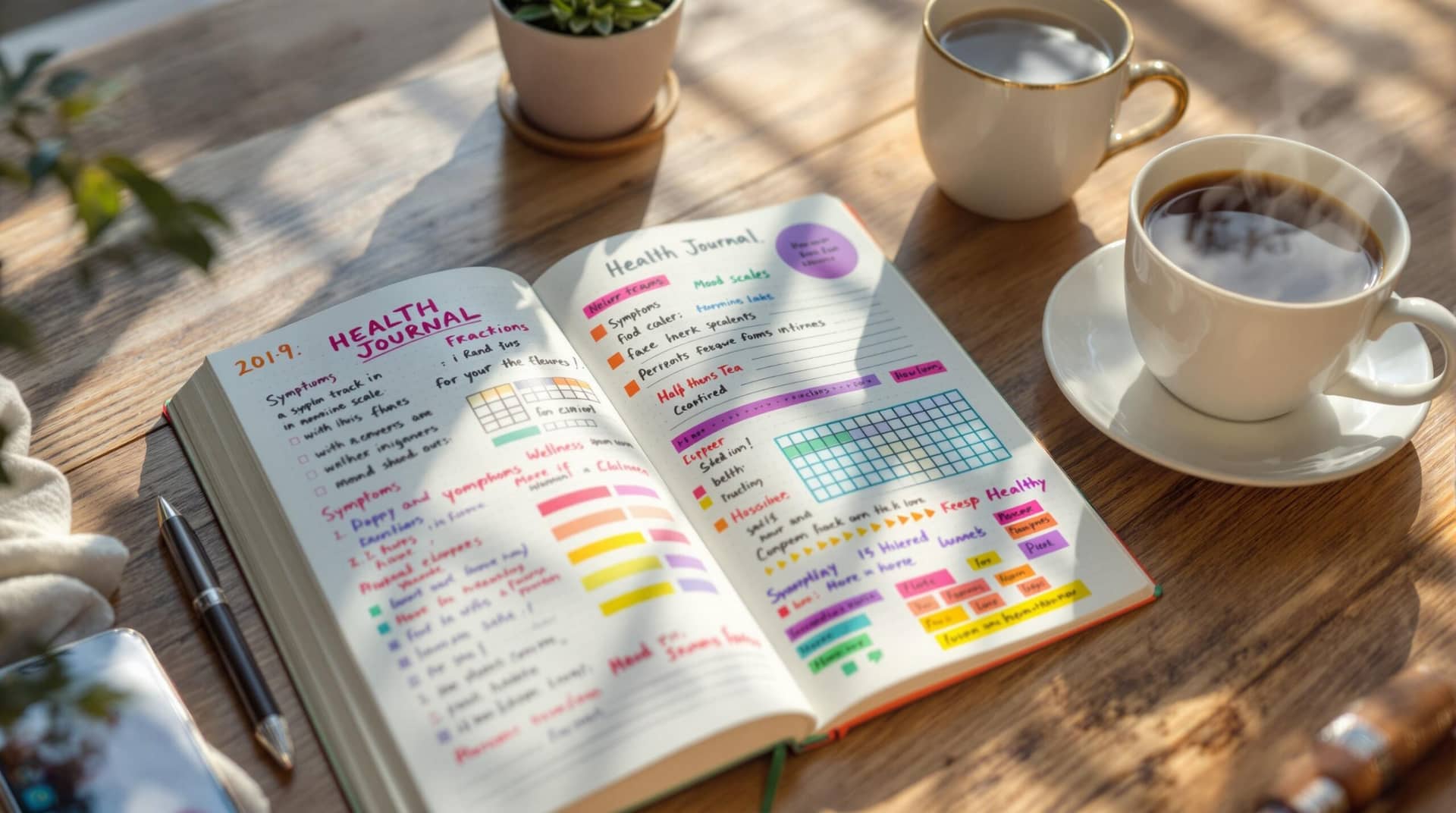
Maybe you’ve tried tracking your health before—started strong with detailed logs, then watched the practice fade after a week or two when life got busy. You’re not alone in that pattern. What’s interesting is that the people who stick with health journaling rarely maintain perfect daily records. They’ve discovered something more sustainable: brief, flexible practices that reveal patterns without demanding perfection.
A simple practice of writing for just 15 minutes, three times per week, can reduce cortisol levels by 19% and lower blood pressure within one month. This isn’t speculation—it’s what researchers documented when they studied people who maintained brief, consistent journaling practices.
Health journaling has evolved from personal diary-keeping into a scientifically-backed wellness tool that healthcare providers now recommend alongside traditional treatments. What once seemed like an optional self-help exercise now appears in patient education materials from organizations like the American Diabetes Association and clinical guidance from major medical centers.
This article reveals six evidence-based tracking methods that produce measurable improvements in both mental and physical health, without demanding hours of daily commitment. You’ll learn which approaches work best for specific health concerns, how to avoid the mistakes that cause most people to quit, and how to integrate health journaling into conversations with your healthcare providers.
Quick Answer: Health journaling is a structured practice of regularly recording physical symptoms, emotions, and daily patterns that helps you identify connections between your choices and how your body responds, leading to reduced anxiety, lower stress hormones, and improved management of chronic conditions.
Definition: Health journaling is the practice of tracking physical symptoms alongside emotional states and daily patterns to reveal cause-and-effect relationships that support both self-understanding and collaborative healthcare conversations.
Key Evidence: According to research examining clinical trials by Karen Baikie and Kay Wilhelm, 68% of health journaling interventions outperform control conditions, with the strongest effects for anxiety (9% reduction) and PTSD (6% reduction).
Context: The practice works because it transforms scattered experiences into organized patterns you can actually see and discuss with healthcare providers.
Health journaling works through three mechanisms: it externalizes internal experience, it creates documented patterns you can review over time, and it reduces the cognitive load of trying to remember what happened when. That combination helps you notice connections between triggers and responses that remain invisible day to day. The benefit comes from accumulation rather than any single entry.
The sections that follow will walk you through six specific tracking methods, show you how to avoid the perfectionism trap that derails most journaling practices, and explain how to bring your documented patterns into healthcare conversations in ways that transform the quality of care you receive.
Key Takeaways
- Anxiety reduction: Consistent journaling produces 20-30% reductions in anxiety symptoms compared to control groups, with effects building over weeks rather than appearing immediately
- Brief practice, lasting results: Writing just 15-20 minutes on 3-4 consecutive days creates physical health improvements that persist for months after you stop writing
- Physical health markers: Journaling lowers cortisol by 19%, reduces blood pressure, and improves immune function in ways you can measure
- Pattern recognition: Tracking both symptoms and emotions reveals connections between triggers and physical responses that remain hidden when you track only one dimension
- Healthcare collaboration: Bringing documented patterns to medical appointments transforms conversations with providers into more targeted, effective care
What Makes Health Journaling Different From Regular Diary Writing
Health journaling is not daily storytelling about your life. It is structured observation that combines symptom tracking with emotional reflection to reveal cause-and-effect patterns.
The distinction matters because the two practices produce different outcomes. When you write “Had a hard day at work, came home exhausted,” you’re recording events. When you write “Pain level 7, felt frustrated about canceled exercise plans, noticed this happens most often after poor sleep,” you’re documenting relationships between variables that your healthcare provider can actually work with.
Research confirms this dual approach creates stronger benefits. According to studies by James Pennebaker examining expressive writing outcomes, people who write about both facts and feelings around difficult experiences show improved immune markers, better mood, and fewer health-center visits in the following six months compared to those who write only about neutral topics. The combination of objective observation and emotional context appears to unlock processing that neither dimension provides alone.
Structure makes patterns visible. Health journaling uses consistent categories: physical symptoms, mood ratings, sleep quality, stress events. These categories allow you to see trends over weeks and months. You might notice your migraines cluster around certain times in your cycle, or that your anxiety spikes correlate with specific work situations, or that your pain improves on days when you move your body even briefly. These connections remain invisible in narrative diary entries because the information isn’t organized in ways that support comparison.
The medical community has recognized this value. The American Diabetes Association now includes health journaling in patient education materials, noting it helps connect daily choices, emotions, and physical symptoms in ways that support stress reduction and more collaborative healthcare conversations. When you arrive at appointments with documented patterns rather than vague recollections, the quality of the conversation shifts.
Health journaling transforms scattered symptoms into documented patterns that both you and your healthcare providers can use to identify triggers, adjust treatments, and track what actually helps your specific body.

The Science Behind Pattern Recognition
James Pennebaker’s pioneering research in the 1980s established that translating experiences into words helps your brain process and organize information differently than simply thinking about events. When you write, you create distance between yourself and the experience, allowing reflection rather than pure reaction.
Three decades of subsequent research shows this processing reduces emotional distress while producing measurable changes in immune function, stress hormones, and physical health markers that persist long after writing stops. According to comprehensive reviews of journaling research, the benefits appear to work through multiple pathways: cognitive, emotional, and biological. These create compound effects that strengthen over time.
Six Evidence-Based Tracking Methods That Produce Real Results
Different health journaling methods serve different purposes. The approach that helps someone process trauma won’t necessarily help someone track chronic pain patterns. What follows are six methods with research support, each suited to specific health concerns and situations.
Method 1: The Expressive Writing Protocol
This is Pennebaker’s original approach: write for 15-20 minutes on 3-4 consecutive days about a stressful experience, exploring both what happened and how you felt. Don’t worry about grammar or coherence. The goal is to articulate the experience fully, including the emotions it triggered and the thoughts that keep circling back.
Multiple studies show this brief intervention improves immune function, reduces doctor visits, enhances mood, and accelerates wound healing months later compared to neutral-writing controls. According to meta-analyses of expressive writing research, the effects persist even when people write for just a few days and never return to the practice.
Use this method when processing specific difficult experiences: a diagnosis, a loss, a transition that keeps replaying in your mind. The concentrated format works better than sporadic entries spread over weeks. You don’t need to share this writing with anyone. The processing happens through articulation itself, not through being heard or validated by others.
Method 2: Symptom-Emotion Pairing
Track physical symptoms alongside emotional states in the same entry. Instead of “Pain level 7 today,” write “Pain level 7, felt frustrated about canceled exercise plans, worried this means progression.” The emotional layer reveals what the symptom means to you and how it affects your life beyond the physical sensation.
This method works because recording both dimensions reveals connections you miss when tracking only symptoms or only moods. You might discover your pain intensifies not just with physical activity but with anxiety about the future. Or that fatigue correlates less with sleep hours than with emotional depletion from specific interactions.
The University of Rochester Medical Center recommends this approach for recognizing symptom triggers and patterns over time. When you bring this paired data to appointments, providers can see not just what’s happening in your body but how it’s affecting your daily functioning and emotional well-being.
A practical format: rate symptom intensity on a 0-10 scale, note your emotional response in a sentence, and identify any context or potential trigger. Keep entries brief. Three to five sentences captures enough information without becoming burdensome.
Method 3: Positive Affect Journaling
Focus on meaningful moments, gratitude, and what went well each day rather than problems or symptoms. This isn’t about denying difficulty or forcing positivity. It’s about training attention toward experiences that support well-being, which most of us naturally overlook in favor of what went wrong.
A 12-week Positive Affect Journaling trial with patients who had elevated anxiety and medical conditions showed lower mental distress, anxiety, and perceived stress, plus better resilience and fewer days when pain interfered with activities compared to usual care. According to research on this intervention, the practice appears to shift baseline mood and stress reactivity rather than just providing temporary relief.
The format is simple: identify two to three positive moments daily, explain why they mattered, and notice how they felt physically. “Had coffee with a friend who made me laugh—felt lighter in my chest, noticed my shoulders dropped” captures the complete picture. This method complements rather than replaces processing difficulties. You can track both struggles and moments of ease without contradiction.
Method 4: Pre-Appointment Documentation
Track patterns for two to four weeks before medical visits, noting symptom timing, intensity, triggers, and what helps. This transforms appointments from “How have you been?” into “I’ve noticed X happens when Y—what might that indicate?”
Healthcare providers work with better information when you arrive with documented patterns rather than general impressions. “My pain is usually bad” provides less to work with than “My pain averages 6-7 most days but spikes to 8-9 on days when I sleep less than six hours or skip meals, and drops to 4-5 when I walk for 20 minutes in the morning.”
Survey data shows 88% of people using structured reflective journaling report greater focus and mental clarity. According to research on journaling benefits, this clarity extends to healthcare conversations. You remember what you wanted to ask, you provide relevant context, and you can advocate more effectively for what you need.
Method 5: Micro-Journaling
Brief daily check-ins of two to three sentences focusing on one notable connection or pattern. “Noticed my anxiety was lower on the day I didn’t check email before breakfast” or “Pain increased after sitting through long meeting—pattern worth tracking.”
This method addresses the sustainability problem that derails many journaling practices. According to research on brief interventions, 15-minute sessions three days per week produce a 19% cortisol reduction and measurable blood pressure improvements within one month. You don’t need comprehensive daily entries to see biological changes.
The lower barrier to entry means higher long-term adherence. When journaling takes 90 seconds instead of 20 minutes, you’re more likely to maintain the practice through busy weeks, low-energy periods, and times when sitting down to write feels impossible.
Format examples that work: “Noticed…”, “Pattern I’m seeing…”, “Connection between…” These sentence stems bypass the blank-page freeze and focus attention on observation rather than storytelling.
Method 6: Hybrid Quantitative-Qualitative Tracking
Combine numerical ratings (sleep hours, pain levels, mood on a 1-10 scale) with brief written reflections. The numbers show trends over time. The words explain context and meaning.
This approach reveals patterns that pure data or pure narrative miss. A graph might show your pain level dropped from 7 to 4 over two weeks, but without the qualitative notes you won’t remember that’s when you started walking in the morning or stopped eating dairy or reduced your work hours. The combination creates actionable insight.
Digital tools make this easier: apps can graph quantitative data while preserving your written reflections. But paper works fine if you prefer it. Draw a simple chart for your numerical tracking and write a few sentences of context below each entry.
Use this method when managing chronic conditions where both objective metrics and subjective experience matter. Blood sugar numbers tell part of the story. How you felt when those numbers were high or low, what was happening in your life, and what interventions you tried—that’s the rest of the story that makes the data meaningful.
The most effective health journaling combines measurable data with emotional context. Tracking what happened alongside how it felt creates the complete picture that reveals true patterns.
Common Mistakes That Undermine Journaling Benefits
The perfectionism trap derails more journaling practices than any other factor. When you treat journaling as another task to grade yourself on (complete entries, consistent format, daily adherence), you’ve transformed a tool for noticing into a source of additional stress.
Missing days triggers guilt that compounds until you abandon the practice entirely. But research shows benefits from modest, sustainable practices rather than perfect daily adherence. Writing three times one week and zero times the next still counts as journaling. The entries you do complete create value. The ones you skip don’t erase previous benefits.
Pure symptom logging misses half the value. Recording “pain 7” without emotional context or pattern notes gives you a number but not understanding. The emotional layer (how the pain affected your day, what you were worried about, what story you told yourself about it) reveals the experience behind the data.
Forced daily practice often leads to abandonment. When journaling becomes a rigid requirement, it starts feeling like homework. Flexible schedules (three to four times weekly, or before appointments, or when something notable happens) show better long-term adherence because they fit actual human lives rather than idealized routines.
Some people experience increased distress from certain journaling approaches. About 10-15% of people may feel more distressed when writing extensively about trauma without adequate support, particularly if they ruminate rather than process. According to research on expressive writing, this happens when people replay traumatic events without moving toward resolution or new understanding.
If writing about something leaves you feeling worse rather than relieved after several sessions, that’s information. It might mean you need a different method (perhaps positive affect journaling instead of trauma-focused writing). Or it might mean you need professional support to process what you’re working through. Journaling complements therapy but doesn’t replace it when you’re dealing with significant trauma.
Self-criticism journaling contra
Frequently Asked Questions
What is health journaling?
Health journaling is the structured practice of tracking physical symptoms alongside emotional states and daily patterns to reveal cause-and-effect relationships that support both self-understanding and collaborative healthcare conversations.
How often should I write in a health journal?
Writing for 15-20 minutes just 3-4 times per week produces measurable benefits including 19% cortisol reduction and lower blood pressure within one month. Daily entries aren’t necessary for results.
What’s the difference between health journaling and regular diary writing?
Health journaling uses structured categories like symptom tracking, mood ratings, and triggers to reveal patterns, while diary writing focuses on storytelling. The structure makes connections visible that narrative entries miss.
Can health journaling actually improve physical health?
Yes, research shows health journaling reduces cortisol by 19%, lowers blood pressure, improves immune function, and decreases doctor visits. The benefits persist for months after stopping the practice.
What should I track in my health journal?
Track both physical symptoms and emotional responses together. Rate symptom intensity, note your emotional reaction, and identify any triggers or context. This pairing reveals connections you miss tracking only one dimension.
How do I bring my health journal to medical appointments?
Document patterns for 2-4 weeks before visits, noting symptom timing, triggers, and what helps. This transforms appointments from vague discussions into targeted conversations with specific data providers can use.
Sources
- LifeLight – Meta-analysis of expressive writing research showing anxiety reductions and long-term physical health benefits from structured journaling interventions
- Lamhe Now – Comprehensive review of journaling outcome research including effectiveness rates and Positive Affect Journaling trial results for patients with anxiety and medical conditions
- Mindsera – Survey data on mental health improvements and historical overview of journaling research spanning three decades
- The Supportive Care – Study data on cortisol reduction and blood pressure improvements from brief journaling, plus workplace wellness program outcomes
- American Diabetes Association – Patient education materials on health journaling for symptom tracking, stress reduction, and healthcare communication
- University of Rochester Medical Center – Clinical guidance on journaling for anxiety management, stress reduction, and symptom pattern recognition
- Mental Health Center – Clinical perspectives on how expressive writing supports emotional processing and reduces psychological distress
