
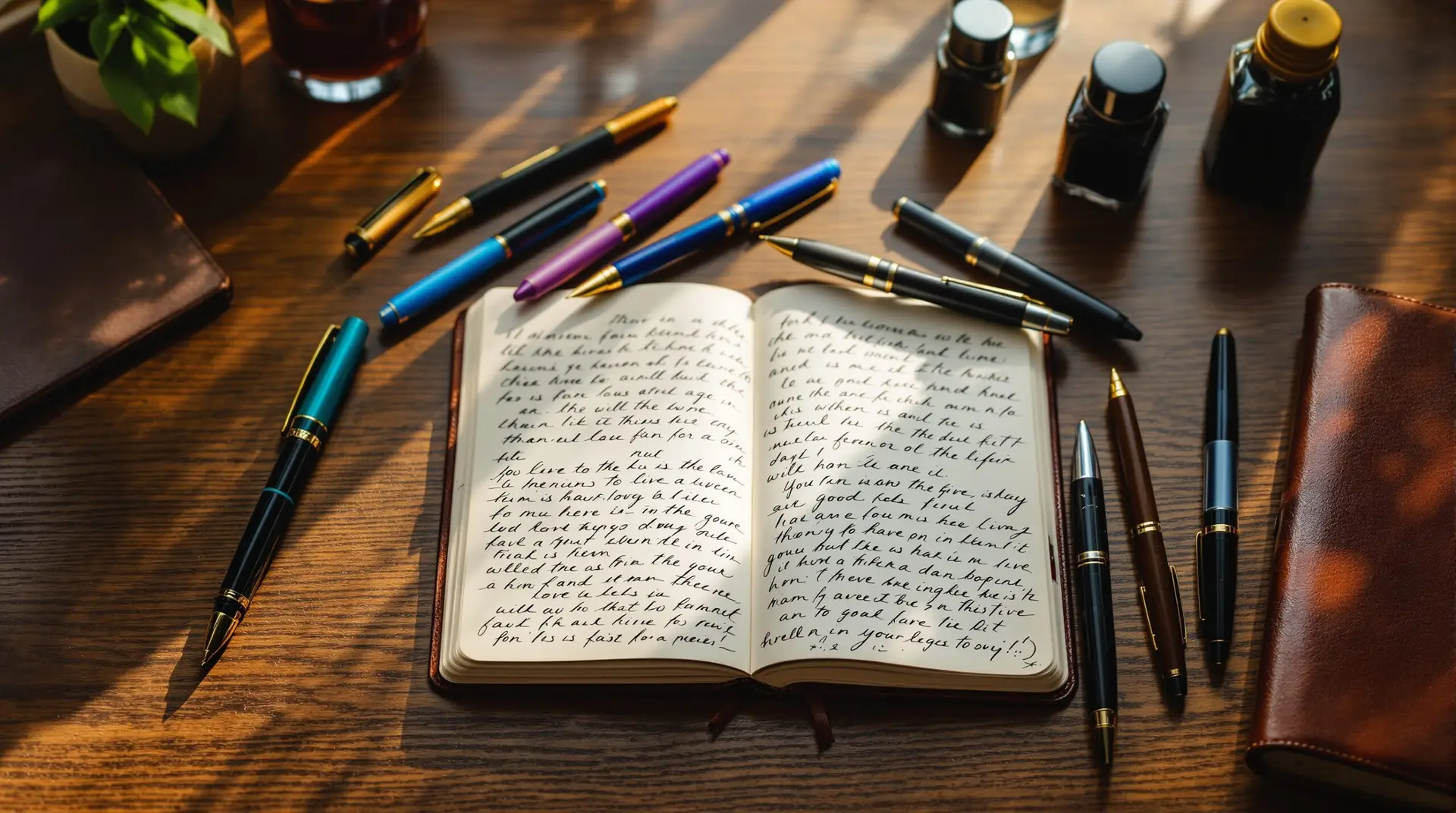
The right pen transforms journaling from a frustrating chore into a flowing practice where thoughts move freely from mind to page—but with thousands of options claiming to be “perfect for journaling,” how do you choose? Pens for journaling are not just any writing tool but instruments designed to remove friction between inner experience and the page. They are writing instruments specifically chosen for smooth ink delivery, minimal bleed-through, and comfortable grip to support sustained self-reflection practices without technical interruption.
While no formal studies measure pen impact on emotional wellness, practitioner reviews reveal clear patterns: gel pens provide smooth, expressive writing, fineliners offer consistent lines for detailed work, and felt-tips deliver vibrant color without heavy ghosting. The journaling community has shifted from bleed-prone rollerballs toward options that honor the imperfect, exploratory nature of self-reflection work.
Quick Answer: The best pens for journaling are gel pens like Uni-ball Signo for smooth flow, fineliners like Stabilo Point 88 for detailed tracking, and felt-tips like PaperMate Flair for vibrant expression—each serving distinct journaling styles without bleeding through quality paper.
Definition: Pens for journaling are writing instruments specifically chosen for smooth ink delivery, minimal bleed-through, and comfortable grip to support sustained self-reflection practices without technical interruption.
Key Evidence: According to GetOrganizedHQ research, PaperMate InkJoy Gel pens rate 5/5 for writing feel with comfortable grip and low smear properties, available in 14 colors at 0.7mm tip size.
Context: The right pen simply removes friction between your thoughts and the page, allowing patterns to emerge without judgment over time.
Journaling works because it externalizes internal experience, reducing cognitive load and creating distance between stimulus and response. When you write regularly, scattered thoughts turn into recognizable patterns, allowing awareness to replace reactivity. That combination reduces rumination and increases choice in how you respond. The sections that follow will walk you through exactly which pens for journaling support this process and how to choose tools that honor rather than hinder your practice.
Key Takeaways
- Gel pens excel for flow: Smooth ink delivery supports stream-of-consciousness writing without skipping or pressure requirements
- Fineliners enable precision: 0.4mm tips like Stabilo Point 88 create consistent lines for habit trackers without bleeding
- Paper compatibility matters: Test pens in your specific journal before committing to prevent ghosting frustration
- Durability supports practice: Metal-enclosed tips in Sakura Pigma Micron pens honor long-term commitment
- Quick-drying prevents smearing: Fast-drying inks allow uninterrupted flow during vulnerable writing sessions
What Makes a Pen Ideal for Journaling
Maybe you’ve experienced the frustration of a pen that skips mid-sentence when you’re capturing an important insight—that interruption can derail your entire thought. Pens for journaling aren’t just writing tools but bridges between your inner world and the page. The difference between a pen that supports your practice and one that creates friction can determine whether you show up consistently or abandon another half-filled journal.
Smooth ink flow stands as the most crucial characteristic. Research by GetOrganizedHQ specialists shows that PaperMate InkJoy Gel pens rate 5/5 for writing feel, reducing physical barriers during emotionally vulnerable sessions. The pen must deliver consistent ink without skipping or requiring heavy pressure—exactly what you don’t need when capturing fleeting insights. When you’re processing difficult emotions or chasing an emerging realization, the last thing you need is a pen that stutters or requires pressure that interrupts your flow.
Minimal bleed-through protects both your current page and your future practice. Quality journaling pens work on various paper weights without ghosting. Studies from The Journal Shop research team demonstrate that Zebra Mildliner highlighters provide smooth ink flow and quick-drying properties across 15 colors with minimal bleed-through on quality paper. The frustration of seeing yesterday’s entry bleeding through today’s blank page can derail your entire session before you write a word.
The Three Core Categories
Different journaling approaches require different tools, each serving distinct purposes in your self-reflection practice.

- Gel pens: Best for expressive, flowing writing where stories unfold without interruption
- Fineliners: Excel in detailed work like habit tracking, doodles, structured layouts that identify patterns
- Felt-tips: Offer color variety for mood tracking and visual journaling that engages different awareness pathways
Top Pens for Journaling by Style and Purpose
You might notice that what works beautifully for morning pages frustrates you during detailed mood tracking—and that’s exactly why understanding these categories matters. The journaling pen landscape centers on options that serve distinct applications, each supporting different aspects of self-discovery work.
For stream-of-consciousness writing, prioritize smooth flow over precision. Testing by GetOrganizedHQ experts confirms that PaperMate InkJoy Gel pens earn perfect 5/5 ratings for writing feel with low smear properties across 14 colors. Uni-ball Signo 207 gel pens remove physical friction with 0.7mm tips, available in 8 colors for basic mood tracking without overwhelming choices. These tools disappear during use, letting your thoughts flow without technical interruption.
For detailed tracking and structured layouts, precision becomes paramount. Research from PageFlutter analysts confirms that Stabilo Point 88 fineliners with 0.4mm tips deliver smoother, more consistent lines than comparable options across 47 colors, proving ideal for bullet journaling without bleeding. Sakura Pigma Micron pens feature metal-enclosed tips for durability with rich black ink, gaining popularity in journaling communities through multipacks of varied nib sizes. These tools honor the detailed work of pattern recognition that reveals insights over time.
For creative expression and visual journaling, color variety opens new pathways for processing experience. PaperMate Flair pens offer 32 colors with smudge-resistant water-based ink, earning 5/5 ratings for writing feel though potential ghosting requires paper testing. Zebra Mildliners provide double-ended functionality across 15 muted colors with quick-drying properties that prevent smearing during rapid creative bursts.
One common pattern looks like this: someone starts journaling with whatever pen is handy, gets frustrated with skipping or bleeding, then assumes they’re “not good at journaling.” The issue isn’t your ability—it’s tool-practice mismatch. Notice what comes up for you with different tools. Some people find that switching from black ink to color unlocks emotional expression they didn’t know was waiting.
Choosing the Right Pen for Your Journal Practice
Matching tools to your specific journaling approach prevents the kind of friction that turns self-reflection into frustration. The wrong pen doesn’t just create technical problems—it can interrupt the vulnerable state necessary for authentic exploration.
Common mistakes reveal themselves through community experience. Using bleed-prone inks on thin journals creates tool-paper mismatch frustration, not writing problems. The issue isn’t your technique but the combination. Hesitating with felt-tip pens causes uneven ink distribution that triggers perfectionism—exactly what you don’t need during emotional processing. Choosing ballpoints for smooth flow often disappoints, as they consistently rate lower for writing pleasure despite reliability.
Best practices emerge from understanding how tools affect your actual experience. Test before committing by writing a full page in your specific journal to check bleed-through and ghosting. Match tip size to purpose: 0.4mm for precision tracking where details matter, 0.7mm to 1.0mm for rapid free-writing where speed supports flow. According to PageFlutter research, LePens offer elegant feel without hand fatigue for extended practice sessions—physical comfort directly affects whether you can sustain longer entries.
Paper compatibility considerations shape your entire experience. Pen-paper compatibility directly affects the journaling experience, as what performs beautifully on high-quality paper may ghost on standard notebooks. Testing combinations beforehand honors your practice by preventing frustration during vulnerable writing spaces. This isn’t perfectionism—it’s practical wisdom that protects your willingness to show up.
Building Your Journaling Pen Collection
Start simple and expand based on actual needs discovered through practice, not anticipated preferences.
- Foundation: One quality gel pen (Uni-ball Signo 207) for daily writing and emotional processing
- Tracking addition: Basic fineliner set (Stabilo Point 88, 3-5 colors) if you develop habit grids or detailed layouts
- Creative expansion: Felt-tips or metallics (Sakura Gelly Roll) only after establishing consistent practice
Emerging Trends in Journaling Pens
Recent developments in journaling tools reflect deeper shifts in how people approach self-reflection work. The evolution moves beyond simple writing instruments toward tools that actively support different aspects of the inner journey.
Multi-functional tools like double-ended Zebra Mildliners combine highlighting and lettering capabilities across 15 muted colors, supporting flexible creative expression without carrying multiple tools. This reflects broader interest in streamlined practices that reduce barriers to consistent showing up—when the setup is simple, you’re more likely to actually use it.
Erasable options address a common block to authentic journaling. According to GetOrganizedHQ researchers, Pilot Frixion gels in 16 colors give permission to explore without permanent commitment. Notice what comes up when you have permission to erase: does it free you to write more honestly, or does it trigger editing impulses that interrupt flow? The trend reveals growing recognition that different personalities need different supports for vulnerability.
Quality over prestige marks a significant values shift. Reviews increasingly recommend economical high-quality options like PaperMate Flair over premium brands, suggesting accessibility matters more than prestige for sustainable practice. Research from PageFlutter specialists supports this approach—tools should support the work, not become the work itself.
Specialty Options for Specific Needs
Emerging categories address diverse approaches to self-reflection and creative expression.
- Metallic gels: Uni-ball Signo and Sakura Gelly Roll Moonlight create visual interest on dark paper for art journaling
- Fountain pens: Pilot Metro and Lamy Safari maintain niche appeal for contemplative writing experiences
- Accessibility adaptations: Better solutions needed for arthritis, tremors, and sensory sensitivities in journaling tools
Why Pens for Journaling Matter
The physical act of moving pen across paper influences what you’re able to access and express during self-reflection work. While no formal studies quantify this impact, extensive practitioner experience confirms that smooth, reliable tools remove barriers between thoughts and page—allowing patterns to emerge over time without technical frustration interrupting vulnerable moments. As journaling becomes recognized wellness practice, intentional tool selection honors the commitment to sustained self-discovery rather than accepting whatever’s convenient. The right pen doesn’t make journaling happen, but it removes one obstacle to showing up authentically with your inner experience.
Conclusion
The best pens for journaling aren’t the most expensive or trendy—they’re the ones that disappear during use, letting your thoughts flow without technical interruption. Gel pens like Uni-ball Signo provide smooth writing for expressive entries, fineliners like Stabilo Point 88 enable precise tracking without bleeding, and felt-tips like PaperMate Flair offer vibrant color for creative exploration. Start with one quality option, test it in your actual journal, and expand your collection only as your practice reveals genuine needs. It’s okay to begin with whatever pen you have right now—the perfect tool won’t create the perfect practice, but showing up consistently will. Your journal will still be there when you come back, imperfect writing and all, ready to help you notice the patterns that matter most.
Frequently Asked Questions
What makes a pen ideal for journaling?
Pens for journaling need smooth ink flow without skipping, minimal bleed-through on paper, and comfortable grip for extended writing sessions. These features remove friction between your thoughts and the page during self-reflection.
What are the best gel pens for journaling?
Uni-ball Signo 207 and PaperMate InkJoy Gel pens excel for journaling with smooth 0.7mm tips, low smear properties, and multiple colors. Both rate 5/5 for writing feel and support stream-of-consciousness writing without interruption.
What is the difference between gel pens and fineliners for journaling?
Gel pens provide smooth flow for expressive writing and emotional processing, while fineliners like Stabilo Point 88 offer precise 0.4mm tips for detailed tracking and structured layouts without bleeding through quality paper.
Do felt-tip pens work well for journaling?
Felt-tip pens like PaperMate Flair offer vibrant colors and smooth writing for creative journaling and mood tracking. They provide 32 color options with smudge-resistant ink, though you should test for ghosting on your specific paper.
How do I prevent pen bleeding in my journal?
Test pens in your specific journal before committing, choose quality paper-compatible options like Zebra Mildliners, and avoid heavy pressure. Pen-paper compatibility directly affects bleed-through and ghosting issues.
What tip size should I choose for journaling pens?
Use 0.4mm tips for precision work like habit tracking and detailed layouts, and 0.7mm to 1.0mm tips for rapid free-writing and emotional processing where smooth flow matters more than precision.
Sources
- GetOrganizedHQ – Detailed ratings and specifications for gel pens, fineliners, and felt-tip pens popular in planner and journaling communities, including color counts and performance metrics
- The Journal Shop – Overview of Zebra Mildliner characteristics and popularity in bullet journaling applications
- PageFlutter – Comprehensive practitioner comparisons of fineliner, gel, and specialty pen options with specific performance observations and community preferences
- YouTube – Video content on pen recommendations for journaling practice
