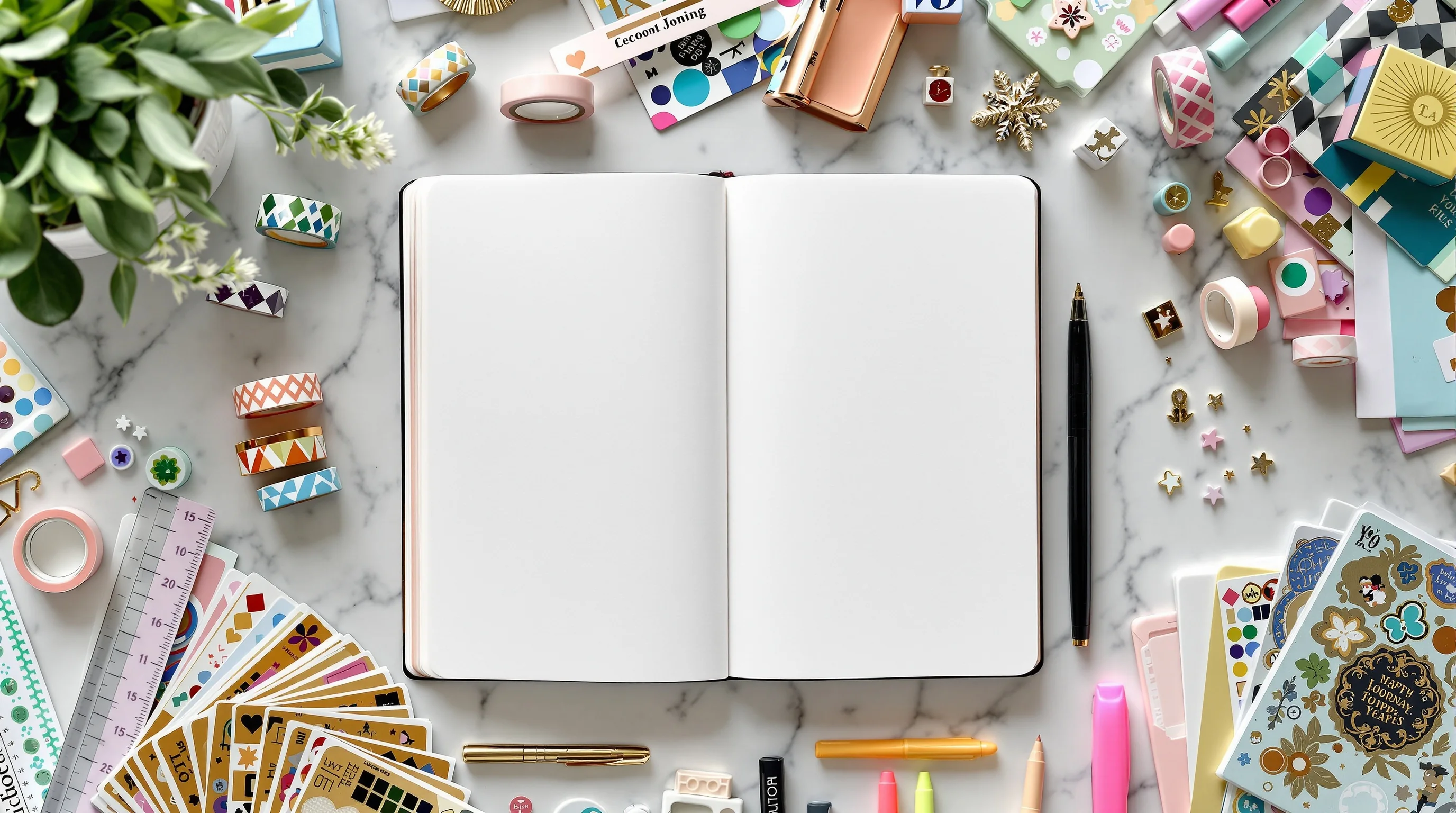
You need two things to start a bullet journal: a notebook whose paper suits your pen, and one pen. That is the whole list. Ryder Carroll's own Bullet Journal FAQ answers "What do I need to Bullet Journal?" with "A notebook and something to write with", and adds that the method is about how you use a notebook, whichever one it is.
Everything else sold as a bullet journal supply is either a convenience you can add later or decoration. This page sorts the usual shopping list into need, optional and skip, gives you a starter kit you can buy in one trip, shows what the two-item version of a spread looks like, and ends with four questions to ask before you buy anything more.
Quick Answer: Buy a notebook whose paper suits the pen you already like, and one pen. Add a second colour, a ruler and a roll of washi tape only if you find yourself reaching for them in the first month. Skip brush pens until you have kept the journal for 30 days, skip stencils altogether, and treat stickers and stamps as decoration.
Key Evidence: The official Bullet Journal FAQ lists the requirements as "a notebook and something to write with". The Leuchtturm1917 A5 notebook that the method's own edition is built on uses 80 g/m² paper, so the 120 gsm "minimum" repeated in supply guides is a preference for heavy pens, and no requirement of the method.
Key Takeaways
- Choose the pen first, then the notebook. Test the pen on the last page of the notebook before you write on page one.
- Dot grid is the default because it is the most forgiving of the three page types. Lined works fine if you mostly write sentences.
- A5 fits a bag and gives a full week on one page. A6 fits a pocket and forces short entries.
- One colour of ink is enough for a working journal. A weekly log needs two at most.
- Give any new supply a 30-day wait. If you are still reaching for it after a month of entries, buy it.
The two things you need
In The Art of Journaling, chapter 3, I set out four factors for choosing a physical journal: size, paper quality, binding and page format. The same four settle a bullet journal notebook.
- Size: A5 (about 5.8 by 8.3 inches) is the common choice and the one most spreads are designed for. A6 if you want it in a coat pocket. A4 if you write at a desk and want a whole month on a page.
- Paper: the paper only has to suit your pen. Leuchtturm1917's standard notebooks, the ones the official Bullet Journal edition is based on, use 80 g/m² paper. A 0.5 mm gel or a ballpoint writes on that with slight ghosting and no bleed. Fountain pens with wet nibs and brush pens want heavier paper, so if that is your pen, buy for it.
- Binding: thread-bound hardcover survives a year in a bag. Spiral lies flat and is cheaper.
- Format: dot grid for anything with tables or trackers, lined if you mostly write prose, blank if you sketch.
The pen: one black gel or fineliner, 0.5 mm or finer, that dries fast enough for your hand. The pens comparison on this site covers dry time and bleed by pen type. Before you commit, write a line of your usual handwriting on the last page of the notebook, let it dry, and turn the page over. If you can read it from the back, change the pen or the notebook.
A starter kit you can buy in one trip
| Item | Need or optional | What it is for | Cheap substitute | Skip until |
|---|---|---|---|---|
| Dot grid notebook, A5 | Need | Everything | Any notebook in the house with paper your pen does not bleed through | Never skip |
| One black pen, 0.5 mm or finer | Need | Everything | The pen you already write with | Never skip |
| Second colour pen | Optional | Marking priorities or appointments | Underlining, or a box round the item | You have a weekly log with more than one kind of entry |
| Ruler | Optional | Straight lines for tables | The edge of a credit card | Your first tracker |
| Washi tape | Optional | Tabs and page flags | A folded corner or a sticky note | You need to find a page repeatedly |
| Brush pens | Skip for now | Lettering headers | Block capitals | You have kept the journal 30 days |
| Stencils | Skip | Boxes and icons | A credit card edge does the same | Never |
| Stickers and stamps | Skip | Decoration | Nothing; they do no job | Only if decorating is the point for you |
| Set of 24 dual-tip markers | Skip | Colour coding | Two pens | You have a colour key with more than three entries |
The first two rows are the method. The rest is furniture.
The minimum viable spread
With the two required items, a day's entry looks like this:
Tue 16 Sep
. call the bank about the standing order
. draft the Q3 note for Sam
o dentist 14:30
One line: slept badly, said yes to two things I should have declined.
A dated line, three bullets in Carroll's notation (a dot for a task, a circle for an event), and one honest sentence. That is a complete bullet journal day. Nothing on the page needed a ruler, a second colour or a header, and a bad day can still manage it in under two minutes.
Why the supply culture backfires
Bullet journaling went public through photographs, and photographs select for the pages worth photographing. The result is a visual standard, colour-coded and lettered, that has nothing to do with the method and a great deal to do with what gets shared. The cost lands on the person who buys the kit before writing a word. An expensive notebook teaches you that rough thoughts do not belong in it. A spread that took an hour to draw on Sunday is a spread you will avoid on the Wednesday that goes wrong, because a scrawled entry would spoil it. Designing the container starts to replace filling it.
My own journaling was on paper, mostly, and later digital, kept around business objectives during executive roles and dropped 15 years ago. I could not tell you the brand of a single notebook. What I remember is that the journal was for thinking, and that meeting notes and board preparation lived elsewhere, in minutes and task lists. Nothing about the supplies mattered enough to stay in memory, which is its own answer to the shopping list.
When the minimal kit does not work
Some people do better with structure they did not have to build. If you have ADHD, or you are in a stretch of life where deciding a page layout each week is one decision too many, a pre-printed planner with fixed sections can leave more attention for the entries themselves. That is a choice about format and it says nothing about discipline. The guide to choosing a bullet journal system on this site compares open notebooks with structured planners.
Four questions before you buy anything
Each example is illustrative.
- Will this serve more than one purpose? A ruler passes: tables, underlines, tearing a page cleanly. A stencil of 30 habit-tracker icons fails, because it draws one thing.
- Does it match how I actually journal? Suppose your last 20 entries are text with the odd tick box. A pad of watercolour paper matches the journal you imagine keeping. Your pen and a lined notebook match the one you keep.
- Will I use it often enough to justify storing it? A set of 24 dual-tip markers fails this for most people, because a weekly log uses two colours at most and the other 22 live in a drawer.
- Could I get the same result with something I already own? A washi-tape tab does what a folded corner does. A bookmark does what a ribbon does. Buy it when the substitute has annoyed you three times.
Why Bullet Journal Supplies Matter
The supplies decide, before you have written anything, how much a blank page costs you. A notebook and pen you are not afraid of make a two-minute entry possible on a day when two minutes is all there is, and those days are the ones that decide whether the habit survives its first month. A kit that has to be honoured turns every skipped day into a small failure. Buy for the bad Wednesday and the good Sunday looks after itself.
Related reading
- Best Pens for Journaling: How to Choose by Type, Paper, and Hand
- Best Bullet Journal: What Bullet Journaling Is and How to Choose Your System
- Bullet Journal Ideas for Beginners: Layouts, Monthly Spreads, and Seasonal Themes
- Getting Started: A Beginner's Guide to Journaling
Sources
- Bullet Journal, Frequently Asked Questions – "What do I need to Bullet Journal? A notebook and something to write with", and the statement that the method is about how you use a notebook
- Leuchtturm1917, Notebook Classic – the A5 Medium hardcover specification: 251 pages, 80 g/m² paper