
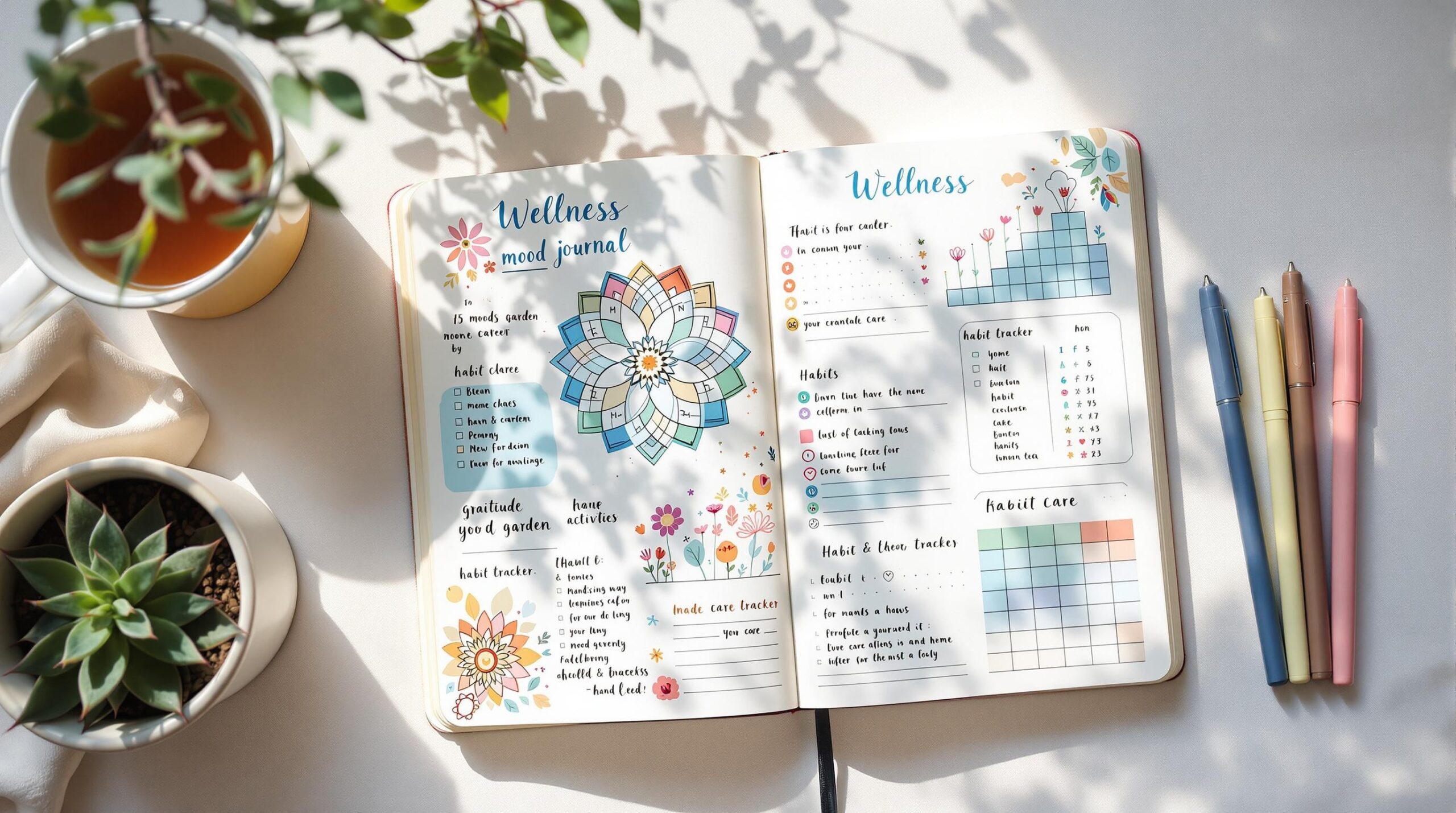
Put two pages in your bullet journal to start: a mood-and-sleep tracker and a weekly "what I am noticing" reflection. The tracker gives you data in thirty seconds a day; the reflection page is where the data turns into something you can act on. The other eighteen pages below are worth adding one at a time, once the first two have survived a month.
Every page idea comes with the same four lines: what you draw, what you write each day, how long it takes, and what to look for after four weeks. Three of the most-used layouts are drawn in text so you can copy them without a photo.
Quick Answer: Start with a mood-and-sleep combo tracker (two columns a day, 30 rows) and a weekly reflection page. Add a year-in-pixels grid if you want a whole year on one page and a trigger-and-coping spread if anxiety is the problem. Retire any page you dread opening two weeks running. Twenty page ideas follow, each with a layout, a daily entry, a time cost and what to look for after four weeks.
Definition: A mood or wellness page in a bullet journal is a Collection, in Ryder Carroll's terms: a dedicated page outside the daily log that records one thing over time so it can be found and read back.
Key Evidence: A 2018 randomised trial by Smyth and colleagues (70 adults with medical conditions and raised anxiety) found that 15-minute positive affect journaling sessions, three days a week for 12 weeks, were associated with lower distress and higher well-being scores than usual care. That was writing, with no grid. The trackers here earn their place only with a reflection page next to them.
Key Takeaways
- Start with two pages: the mood-and-sleep combo tracker and the weekly "what I am noticing" page. Add a third only after four weeks.
- Use words for your scale if naming feelings is hard, colours if you want a five-second daily fill, numbers only if you plan to chart.
- Give every tracker a minimum period before you read it: 28 days for mood pages, 8 weeks for the year-in-pixels grid.
- Track mood from 1 to 10 before and after any writing session, the check recommended in 100 Mental Health Journaling Prompts, so the page tells you whether the writing helps.
- Stop rule: if you dread opening a page two weeks running, or a run of grey squares has become evidence against yourself, retire the page.
Choose two pages to start
| Page | Daily time | Minimum period before it says anything | Best for |
|---|---|---|---|
| Mood-and-sleep combo (2) | 30 seconds | 28 days | Finding out whether bad nights come before bad days |
| Weekly "what I am noticing" (13) | 10 minutes, once a week | 4 weeks | Turning any tracker into a decision |
| Year in pixels (1) | 10 seconds | 8 weeks | Seasonal and monthly patterns |
| Trigger-and-coping spread (15) | 2 minutes when something happens | 10 entries | Anxiety spikes; seeing which coping moves work |
| Self-compassion prompt page (10) | 10 minutes, once a week | 4 weeks | Self-criticism |
| Social connection tracker (16) | 10 seconds | 28 days | Isolation |
Pick two. Dan Knowlton's account of his own habit trackers on bulletjournal.com is what happens with more: eight items a month, the first week or two filled in, then blank. His limit settled at four to five habits with a plan for each. The number of things you ask yourself to notice each day has the same ceiling. Keep the thinking on the page next to the tracker: the grid records, and the reflection page is where the record becomes a decision.
Choose a scale
Use words if you struggle to name feelings; choosing between "flat" and "sad" is the useful part. Use colours if you want the page filled in five seconds, and keep the key to five. Use numbers only if you intend to chart them. Decide before you draw the page and keep the scale all month, or the two halves will not compare.
Trackers that reveal patterns
1. Year in pixels
Draw: 12 columns (months) by 31 rows (days), squares about 5 mm, with a five-colour key in the margin. Write: one coloured square per day for your dominant mood. Time: 10 seconds. After four weeks: nothing yet; give it eight.
      J F M A M J J A S O N D
  1  [ ][ ][ ][ ][ ][ ][ ][ ][ ][ ][ ][ ]
  2  [ ][ ][ ][ ][ ][ ][ ][ ][ ][ ][ ][ ]
  ...
 31  [ ][ ][ ][ ][ ][ ][ ][ ][ ][ ][ ][ ]
 Key: calm / good / flat / anxious / low
2. Mood-and-sleep combo
Draw: 30 rows, three columns: date, mood word (or 1 to 5), hours slept. Write: both columns each morning. Time: 30 seconds. After four weeks: mark every night under six hours, then read the mood on the following row.
 Date | Mood (1-5 or word) | Hours slept
 ------------------------------------------
  1   |                    |
  2   |                    |
 ...  |                    |
 30   |                    |
An invented month might read: mood at 2 on the 4th, 9th, 17th, 18th and 26th; hours slept before those days 5, 5.5, 4.5, 6.5 and 5. Every mood below 3 followed a night under six hours except the 18th. The reader has one question (what happened on the 17th) and one decision (sleep is the first thing to protect).
3. Emotion word log
Draw: a dated list, one line a day. Write: the one word that fits (frustrated, hopeful, flat). Time: 20 seconds. After four weeks: count the words; three usually do most of the work.
4. Body sensations check-in
Draw: a simple outline of a body, or four boxes labelled head, chest, stomach, hands. Write: one word or a mark where the tension or heaviness sits. Time: 20 seconds. After four weeks: see whether the same place fills in on the low days.
5. Energy line graph
Draw: a 1 to 5 vertical axis, days along the bottom, one dot a day joined by a line. Write: energy, with output left out of it. Time: 10 seconds. After four weeks: a dip on the same weekday is worth planning around.
6. Weather and mood
Draw: two columns beside the date, weather symbol and mood colour. Write: both, each evening. Time: 15 seconds. After four weeks: a link or none; the second answer lets you drop the page.
7. Mandala mood log
Draw: a circle divided into 30 or 31 segments. Write: colour one segment a day from your key. Time: one minute. After four weeks: the same data as the pixel grid, so keep one of the two.
Self-compassion and reflection pages
Kristin Neff describes self-compassion as mindfulness, common humanity and kindness, given to yourself as you would give them to a friend. These pages ask that friend's question in writing.
8. Gratitude corner
Draw: a small box in the corner of each weekly spread. Write: one specific thing a day, with a name or a place in it. Time: 30 seconds. After four weeks: reread it on a bad day; the specific entries hold up.
9. "What helped today" log
Draw: a dated list. Write: one thing each evening that made the day easier. Time: 30 seconds. After four weeks: the three things that recur are your list for the next bad week.
10. Self-compassion prompt page
Draw: a full page with one prompt at the top, one entry a week. Write: "If I spoke to myself the way I would speak to a close friend, what would I say about this week?" Time: 10 minutes. After four weeks: compare the tone of the first and fourth entries.
11. "The story I am telling myself"
Draw: two columns: the story, and what else might be true. Write: when a strong feeling arrives, the sentence behind it ("no one cares") and one other reading of the same facts. Time: 5 minutes. After four weeks: the story that has appeared twice is the one to take to a friend or a therapist.
12. Permission slip tracker
Draw: a dated list. Write: one thing you gave yourself permission to do or skip. Time: 20 seconds. After four weeks: a page of small choices that honoured a need.
13. Weekly "what I am noticing"
Draw: a full page, dated by week. Write: three to five sentences on Sunday: patterns, surprises, one question. Time: 10 minutes. After four weeks: this page makes the others worth keeping; if it is blank, the trackers are wallpaper.
14. Micro-joy doodle page
Draw: a blank page with a small dated grid. Write: one tiny symbol a day for a moment that was all right. Time: 30 seconds. After four weeks: a page for the weeks when words are too much.
Practical spreads
15. Trigger-and-coping spread
Draw: four columns across a double page. Write: when something difficult happens: the situation, the feeling, what you did, whether it helped (yes, partly, no). Time: 2 minutes per entry. After ten entries: the moves marked "no" are the ones to stop reaching for.
 Situation          | Feeling   | What I did        | Did it help?
 ----------------------------------------------------------------
 Email from boss    | dread     | reread it 6 times | no
 Train cancelled    | panic     | called J.         | yes
16. Social connection tracker
Draw: a month grid with one square a day. Write: a mark on days with real contact. Time: 10 seconds. After four weeks: put it beside the mood page and look at the blank runs.
17. Movement that felt good
Draw: a dated list. Write: the movement that left you better, a slow walk or ten minutes of stretching. Time: 20 seconds. After four weeks: a list of what your body will agree to on a low day.
18. Anxiety storm tracker
Draw: a page of small storm-cloud outlines, or plain boxes. Write: when anxiety spikes, the date, the time and three words on the trigger. Time: one minute. After four weeks: time of day and type of uncertainty usually cluster.
19. Therapy or support themes
Draw: one page per month, dated by session. Write: after each session, the theme, one insight and any homework. Time: 5 minutes. After four weeks: reread before the next appointment and bring in whatever reads differently.
20. Before-and-after session line
Draw: two short 1 to 10 scales, at the top and bottom of any journaling page. Write: your mood before you start writing and again when you stop. Time: 10 seconds. After four weeks: this is the check I ask readers of 100 Mental Health Journaling Prompts to keep: if the after number is consistently lower than the before number, the practice should change or stop.
What to do when tracking makes you feel worse
Three failure modes are common enough to plan for. Surveillance: the page feels like being watched and filling it in becomes a performance; move to the doodle page or the word log, which record without rating. A low stretch: a run of grey squares becomes evidence against yourself; cover the grid for the month and keep only the "what helped" log. Perfectionism: the spread takes twenty minutes to draw, one missed day spoils it, and it is abandoned; Knowlton's advice applies, expect to miss days, make the page easy to fill, and treat coming back as the practice. The stop rule is the same for all three. If you dread opening a page two weeks running, retire it; if the before-and-after numbers on page 20 keep falling, stop the writing and talk to someone.
Why the mood page in your bullet journal matters
A feeling logged once is a data point; the same feeling logged for a month beside hours slept, contact with people and what you did about it is a pattern with a cause attached. That is the case for these pages, and their limit. In Write Your Way, chapter 7, trackers appear as personal additions to the bullet journal system, which exists to make the notebook findable; a tracker earns its place only if something is done with what it shows. The reflection page is where that happens, and it is the one page here to keep if you keep only one.
Related reading
- Bullet Journal Doodles and Headers: Simple Drawing That Supports Your Practice
- How to Create a Habit Tracker Bullet Journal: 7 Simple Steps for Daily Success
- 64 Daily Journal Prompts for Mental Health
- Top Digital Journaling Apps for Mental Health
Sources
- Smyth et al. (2018), JMIR Mental Health, via PMC – 70 adults with medical conditions and raised anxiety symptoms; 15-minute web-based positive affect journaling on 3 days a week for 12 weeks; lower distress and higher well-being scores than usual care
- Dan Knowlton, Intentional Habit Tracking, bulletjournal.com – eight tracked habits a month left spreads with only the first week or two filled in; four to five habits with a plan for each; expect to miss days and make the page easy to fill
- Bullet Journal FAQ, bulletjournal.com – Collections as dedicated pages for information tracked over time; the Index as the way to find them
- Bullet Journal: our story, bulletjournal.com – Ryder Carroll founded Bullet Journal in 2013 and describes his ADHD and his difficulty with formal education as the background to the method
- Kristin Neff, self-compassion.org – the three elements of self-compassion: mindfulness, common humanity and kindness, given to yourself as you would to a friend