You’ve probably held a pen over your Bible’s margin and hesitated, worried about “ruining” something sacred or creating something imperfect. That hesitation is more common than you’d think. Bible journaling is not performance art or theological documentation, it is structured observation of how scripture intersects with your lived experience. According to Sara Laughed, journaling guide, “All you really need is the Bible and a pen that doesn’t bleed through the page” (Sara Laughed). This guide reveals how to start with whatever you have right now, from simple underlining to visual reflection, focusing on noticing patterns in scripture and tracking your spiritual journey without judgment.
Quick Answer: Bible journaling combines scripture reading with visual elements, highlighting, notes, doodles, or art, directly in Bible margins or separate notebooks to deepen personal engagement with sacred texts through pattern recognition and creative reflection, requiring no artistic skill.
Definition: Bible journaling is a devotional practice that records emotions, insights, and spiritual responses through visual marking in scripture, creating a map of how specific passages speak to you over time.
Key Evidence: According to Sara Laughed, experts universally agree that artistic ability is unnecessary for bible journaling, with the practice accessible to anyone who can hold a pen.
Context: This devotional approach has evolved over the past decade from traditional margin annotations to a vibrant, visual practice supported by specialized Bibles and online communities that prioritize spiritual engagement over aesthetic performance.
Bible journaling works through three mechanisms: it externalizes internal spiritual experience, it labels what resonates with visible marks, and it creates pattern data you can review. That combination turns abstract contemplation into recognizable themes, the questions you return to, the promises you need to hear repeatedly, the aspects of God’s character you’re drawn toward. The sections that follow will walk you through exactly how to start, even when you’re intimidated by blank margins, and how to build a sustainable practice that reveals patterns without requiring artistic talent.
Key Takeaways
- No artistic skill required: Bible journaling welcomes complete beginners with simple tools like highlighters and margin notes
- Start micro: Underlining a single meaningful word or adding a sticker counts as complete engagement (HiSpalette)
- Pattern recognition builds self-awareness: Over time, you’ll notice which themes consistently capture your attention
- Simple codes create navigation: Stars for memorization, faces for emotional moments, color-coding by theme (Amy Senter)
- Your journey is incomparable: Each person’s bible journaling practice reveals unique spiritual patterns without needing to match others’ aesthetics
What Bible Journaling Actually Involves (No Art Degree Required)
Maybe you’ve opened journaling Bibles before that now sit mostly empty on a shelf. The difference between abandoned attempts and sustainable practice often comes down to starting smaller than feels significant, one underlined word instead of a decorated page, a single question mark in the margin instead of a full prayer written out.
The core practice involves reading passages, highlighting meaningful phrases, adding notes or prayers, and incorporating visual elements, either in Bible margins or separate journals, to track personal responses without judgment. What you’re creating is a map of your spiritual attention over time. Amy Senter, Bible study educator, emphasizes “The important thing is that you JUST START,” recommending practical techniques like reading for patterns, highlighting freely, and using simple drawings like happy or sad faces to mark emotional responses (Amy Senter). This permission to be imperfect matters because many people have tried journaling before and stopped when it felt like another task to perform correctly.
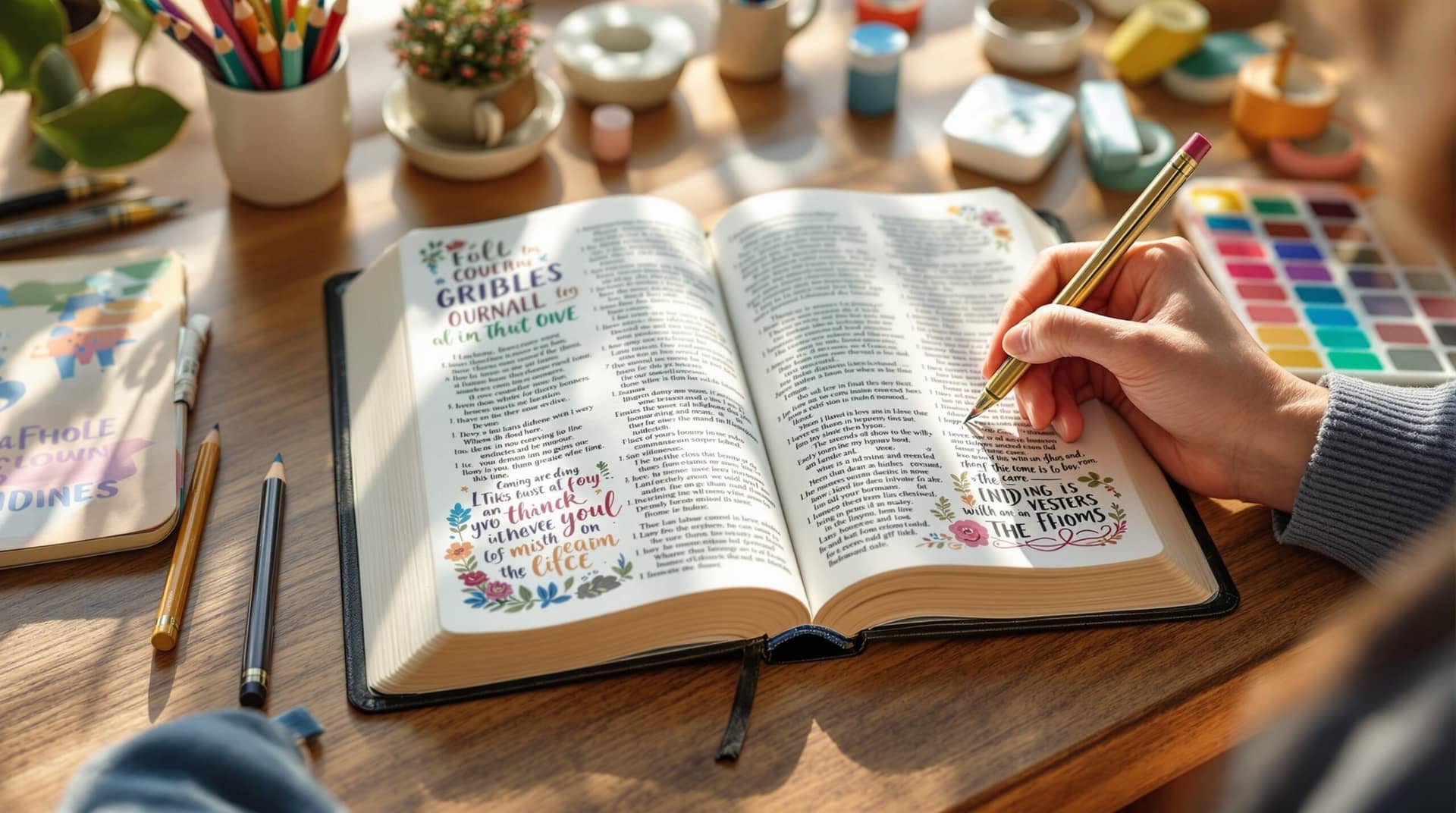
The practice exists on a spectrum, from minimalist margin notes to elaborate mixed-media art. Some people use only colored pencils to underline. Others fill entire pages with watercolor illustrations and hand-lettered verses. What unifies these varied approaches is the focus on noticing patterns in the text and tracking your responses. Bible journaling serves visual learners who retain information better when they see connections mapped out on the page, creating contemplative space to explore faith questions without performance pressure.

Tools That Actually Matter
Your essential starting point is just your Bible and a non-bleeding pen. Pitt Artist Pens, gel pens, and Pigma Microns work well because they won’t show through thin Bible pages, but you can begin with whatever pen you already have. Christa Sterken suggests using gesso for page protection and affordable art pens when experimenting with markers or watercolors (Christa Sterken). These protective techniques let you explore without fear of damaging pages.
Separate notebooks offer an alternative that removes the pressure of working directly in cherished Bibles while building confidence. You can practice techniques, try colors, experiment with layouts, and discover your style before deciding whether to journal in your Bible itself.
Three Places the Practice Shows Up
Bible journaling appears in three main contexts. Personal devotional practice, where you read and then reflect in solitude. Teaching settings, where parents and educators help children and teens paraphrase passages and illustrate stories. And spiritual formation work in retreats, small groups and recovery ministries, which invite participants to connect biblical narratives with their own life stories. Each serves different needs, and all share the same core: space for honest engagement with the text and with yourself.
What the Research Says About Writing, Creativity and Faith
Bible journaling rests on evidence from three adjacent fields. On writing: research by James Pennebaker and colleagues shows that writing about emotional experiences produces measurable benefits, and a 2020 systematic review of 144 studies found expressive writing produces consistent small-to-moderate psychological health benefits, particularly when people move from describing events to exploring what those events reveal about their beliefs and patterns. That is the principle bible journaling works on: not recording what happened, but examining what it means within your faith story.
On gratitude: according to research published in the Journal of Psychotherapy Integration, psychotherapy participants who wrote gratitude letters showed significantly greater mental health improvements at four and twelve weeks than control groups. Bible journaling carries that dimension naturally when you document answered prayers or unexpected moments of comfort.
On creativity: art and visual journaling are widely used to support emotional expression, self-awareness and stress reduction, including with trauma survivors. Grief, rage and even joy are sometimes expressed more honestly through colour and shape than through sentences, which is what the visual side of the practice is for.
When Faith Practice Supports Mental Health
A meta-analysis of the research on religion and mental health found religious and spiritual involvement modestly associated with better mental health and lower depression, and the effect was stronger when spirituality involved internalised meaning-making rather than external ritual alone. That distinction is the point of journaling Scripture: not checking a devotional box, but the personal reflection that makes the text intimate rather than transactional.
How to Start Bible Journaling When You’ve Tried and Stopped Before
If you’re thinking “I should be better at this by now” or “I never stick with journaling,” notice that thought without letting it stop you. The HiSpalette Creative Worship series advocates for minimal techniques like underlining or simple doodling, noting that “Bible journaling is a personal journey for each of us. Your journey will not look like mine or anyone else’s” (HiSpalette). This micro-journaling approach acknowledges that many people need permission to do less, not instructions for doing more.
For your first session, choose a familiar verse that already means something to you. Read it slowly, noticing what details catch your attention, what questions arise, what emotions or memories it stirs. Highlight or underline without any plan, just mark what speaks to you in this moment. That’s complete. You’ve engaged with scripture in a way that’s now visually marked for future reference.
Use curiosity-based prompts rather than evaluative questions. Instead of “What should I learn from this?” try:
- Where do I see myself in this story?
- What surprised me here?
- What does this reveal about how I see God right now?
Questions like these invite exploration rather than grading, and make room for doubt and confusion alongside comfort and clarity.
Research by James Pennebaker shows that writing about meaningful experiences reduces emotional reactivity and creates distance between stimulus and response (American Psychological Association). While his work focused on expressive writing broadly, the principle applies here: externalizing your spiritual reflection through visual marking creates space between reading scripture and reacting to it, allowing patterns to emerge that stay invisible when everything remains internal.
Simple codes make the practice sustainable. Experts recommend highlighting repeated themes, grouping similar notes (genealogies, promises, commands), and using stars for verses you want to memorize or faces as memory aids for emotional moments (Amy Senter). These codes become your personal language for navigating scripture. Over time, you’ll flip through your Bible and see at a glance which passages you’ve lived with most intensely.
Christa Sterken’s artist perspective maintains accessibility: “Simple is perfect” captures her philosophy of beginning with basic verse copying and minimal decoration before advancing to complex techniques (Christa Sterken). This guidance counters the common mistake of overcomplicating first attempts with fancy supplies, fearing you’ll “ruin” your Bible, or comparing your process to polished Instagram examples.
If the fear of marking a new Bible paralyzes you, begin in pencil for erasability, practice in a cheap spiral notebook first, or use stickers and washi tape for decoration without requiring drawing skill. There’s no right way to do this, only the way that lets you actually begin.
Pattern Recognition That Reveals Your Spiritual Journey
Track what consistently captures your attention as you read. You might notice you’re drawn repeatedly to promises, commands, descriptions of God’s character, or human reactions to divine presence. Color-coding by theme helps: mark all references to light, fear, or waiting in one color to create visual threads across chapters. These threads reveal the story you’re telling yourself about faith right now.
This isn’t about analysis or theological correctness. It’s about self-knowledge. Over time you’ll see which stories you return to, patterns in the questions you ask, themes that consistently speak to your current situation. That recognition is the real benefit, not the decorated pages.
Practical Bible Journaling Techniques for Authentic Engagement
The devotional integration that makes bible journaling more than craft time involves praying before you start, reading for personal resonance rather than analysis, referencing commentaries when questions arise, and doodling what the passage brings up, locations, emotions, connections to your own experience. This approach shifts the practice from performance to contemplation, creating space for compassionate self-awareness as you notice what captures your attention and what that reveals.
A practical example: Open a psalm you return to often. Read it once without marking anything. Read again, this time highlighting phrases that resonate today. In the margin, write a one-sentence prayer or question the passage brings up for you. Add a small symbol, sun, heart, question mark, next to verses you want to revisit. That’s complete engagement. You’ve created a record of what this text means to you in this season of your life.
The past eight years have seen a surge in journaling-specific Bibles with wide margins, interleaved editions with blank pages opposite scripture text, and line-art illustrations ready for coloring. These specialized editions remove technical obstacles while creating generous space for reflection. According to Christa Sterken, affordable tools and protective techniques make these Bibles accessible starting points for experimentation.
The current scene reflects a practice in transition from intimidating perfection toward inclusive participation, with experienced practitioners celebrating underlined verses and margin stars alongside decorated pages. Online communities have shifted emphasis from elaborate artwork to the simple act of engagement, normalizing whatever level of visual expression feels authentic to each person.
You might find yourself avoiding your journal when entries start feeling like evidence of inadequacy rather than records of genuine exploration. That avoidance is information, not weakness. It tells you something about the pressure you’re putting on the practice. When that happens, return to the simplest possible action: read one verse and underline one word. That’s enough.
Verse Mapping in a Separate Notebook
Verse mapping keeps the study off the Bible’s pages and gives it room. Write the verse at the top of a notebook page. Underneath, note the key words and what they mean in the original language, using any study Bible or concordance. Add the cross references the verse points to and what each adds. Finish with your personal response: what the verse is asking of you today. One verse a session is plenty.
Building Your Personal Style Without Comparison
Try the opposite-page method if you have an interleaved Bible or separate journal: write the verse on one side, and on the facing page, doodle whatever image or symbol it brings to mind. A verse about mountains might get a simple triangle. Mentions of water could become wavy lines. Let these be rough and immediate rather than refined.
Your style emerges naturally through experimentation over months. Notice which techniques feel natural versus which create resistance. Online communities increasingly emphasize process documentation over finished products, normalizing that bible journaling is contemplative practice, not craft project. The story you’re telling yourself about needing to create Instagram-worthy pages can be replaced with permission to simply notice what the text stirs in you.
For more structured approaches to spiritual reflection, the 30 Christian journaling prompts complement visual bible journaling with guided questions.
What Makes Bible Journaling Sustainable Long-Term
Emerging micro-trends point toward sustainability: simple underlines, stickers, washi tape accents represent a shift toward smaller touches that create visual interest without requiring artistic skill or lengthy sessions. This acknowledges what many people discover through trial and error, that permission to do less, not instructions for doing more, keeps the practice alive.
Hand-lettering has become more accessible through templates and tracing methods that remove intimidation. Pre-printed verses you can color, alphabet guides for simple lettering, and symbol libraries for common themes scaffold creative confidence without demanding immediate expertise. These tools serve as bridges, not destinations.
What unifies varied bible journaling approaches is the focus on noticing patterns in text and tracking your own responses without judgment, creating a personal relationship with scripture over time. The benefit compounds gradually, not through any single session but through the accumulation of observations. You’re building a visual record of your spiritual attention, and that record becomes more valuable the longer you maintain it.
The future trajectory suggests continued emphasis on low-barrier entry points and destigmatization that makes underlining and one-word margin notes as celebrated as elaborate artwork. The practice resists standardization by design. No significant debates exist in this field because there’s no single authority declaring the “right” way to engage with scripture visually. The only gentle emphasis difference appears in whether to start directly in your Bible or practice first in a separate notebook, but the guidance remains consistent: do what reduces your anxiety and lets you actually begin.
Why Bible Journaling Matters
Bible journaling matters because spiritual insight that stays abstract tends to stay theoretical. When you mark a verse, you anchor it to a specific moment in your life. That anchor becomes a reference point you can return to, a visible reminder of what mattered when you were facing particular questions or circumstances. Over time, the collection of these marked moments reveals patterns in your faith journey that would otherwise remain invisible. The practice creates space for self-knowledge without requiring you to have everything figured out first.
Conclusion
Bible journaling offers a low-pressure pathway to spiritual self-discovery through combining scripture reading with visual elements, accessible to anyone regardless of artistic ability. The practice reveals patterns in what captures your attention, the questions that arise when you slow down to notice them, and the story you’re telling yourself about faith, requiring only the courage to start imperfectly. Open your Bible today to a verse you already know, underline one word that speaks to you right now, and add a simple mark in the margin. That single act counts as complete bible journaling, building contemplative space for recognizing your unique spiritual journey without comparison to anyone else’s path.
Related reading
- Advanced Journaling Techniques
- Art Journaling Ideas: Simple Ways to Turn Thoughts Into Pages
- Sacred Pages: How Bible Journaling Transforms Your Spiritual Connection
Sources
- Amy Senter – Bible study educator offering practical techniques for reading patterns, highlighting, grouping notes, and starting without perfection pressure
- Sara Laughed – Journaling guide emphasizing minimal tools needed and beginning with familiar verses to reduce intimidation
- HiSpalette – Creative Worship series advocating micro-journaling and honoring each person’s unique journey without comparison
- Christa Sterken – Artist and author providing simple starting methods, affordable tool recommendations, and protective techniques like gesso
- Michelle Rabon – Beginner resource covering accessible entry points including stickers and basic decoration methods
- YouTube Bible Journaling Tutorials – Video demonstrations of five-step processes for selecting Bibles, verses, and starting with simple techniques
- YouTube Creative Journaling Guide – Tutorial content for building bible journaling skills through step-by-step visual instruction
From the author of this site
The Art of Journaling
The complete guide to starting, keeping, and actually benefiting from a journal, from first blank page to a practice that lasts.