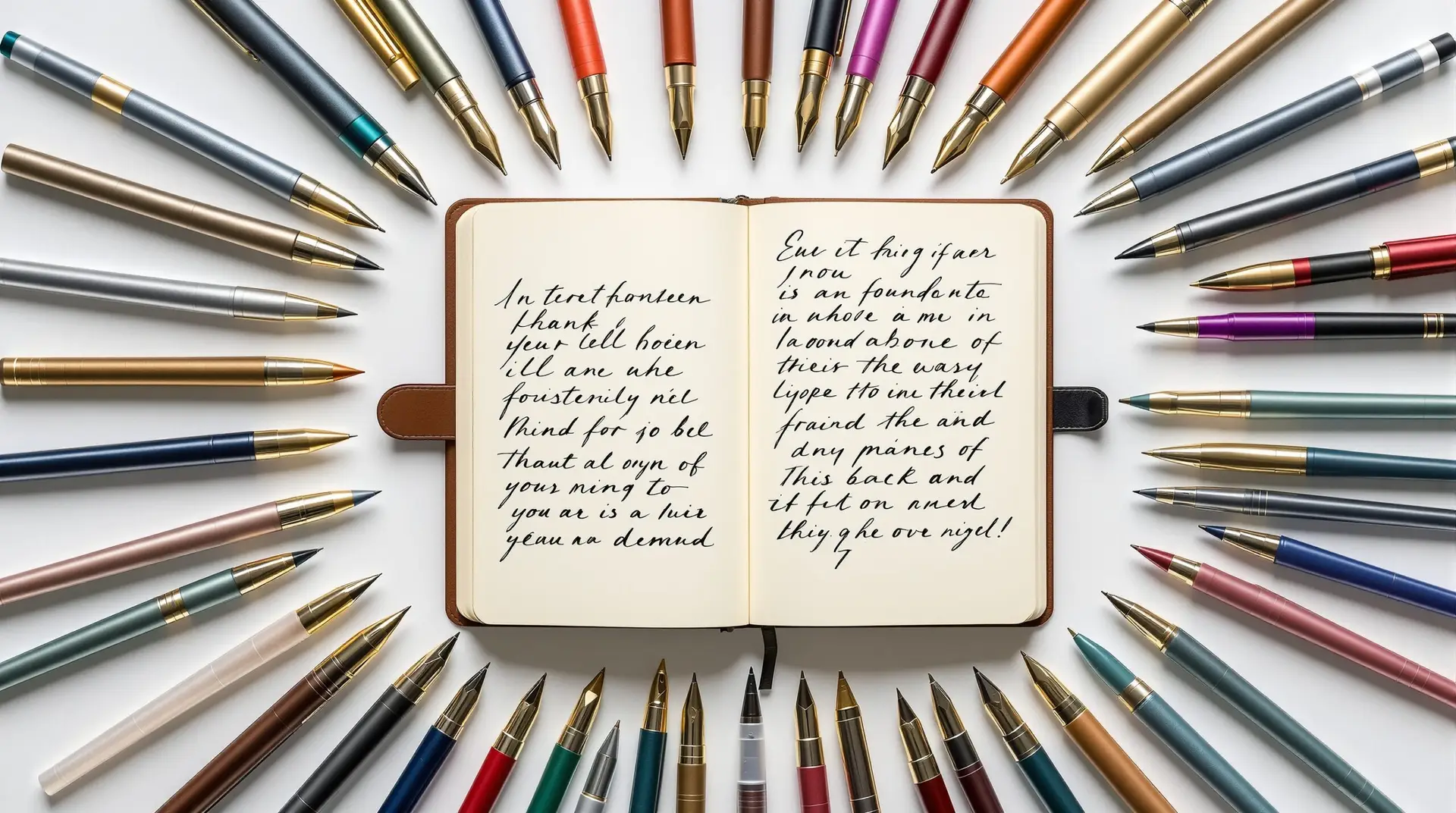
The best pens for journaling shape more than how your words look on the page. They decide whether you write through a difficult entry or stop when your hand cramps after ten minutes, whether yesterday’s ink shows through today’s page, and whether a left hand drags a smear across a sentence you needed to keep. Journalers now prioritise bleed-through resistance, archival quality and comfort over brand prestige, and ink chemistry and paper compatibility matter more than aesthetics.
Quick Answer: The best pens for journaling depend on the paper, the hand and the purpose: quick-dry gels such as the Pentel EnerGel and Zebra Sarasa for everyday writing and left-handers, the hybrid-ink Uniball Jetstream for fast, smear-free notes, ultra-fine gels such as the Pilot Hi-Tec-C for dense reflection, pigment fineliners such as the Sakura Pigma Micron for entries that must last, a ballpoint such as the Zebra F-301 for thin paper, and an entry-level fountain pen such as the Platinum Preppy for slow, deliberate writing.
Definition: Pens for journaling are writing instruments chosen for their ink behaviour, comfort and longevity to support sustained self-reflection and emotional processing.
Key Evidence: According to Print Smitten, pigment-based fineliners are waterproof, fade-resistant and acid-free, making them ideal for journals you will revisit years later.
Context: The comparison table below covers dry time, bleed, left-hand use, archival quality and price band for nineteen pens, filled only from tests the sources actually ran.
Pens for journaling are not about following rules. They are about removing friction between your inner experience and the page, so that the pen disappears from awareness and leaves room for the thoughts and feelings that matter.
Key Takeaways
- Ink formulation matters more than tip size. A 0.5mm water-based fineliner can ghost more than a 0.7mm hybrid ballpoint, depending on ink chemistry.
- Quick-dry gels such as the Pentel EnerGel and Zebra Sarasa showed no smudging on immediate finger contact in a smudge test on real bullet journal paper, which makes them the safe choice for left-handed writers.
- Ultra-fine gel pens (0.38-0.5mm) allow dense reflection and pattern-tracking in small spaces without overwhelming the page.
- Erasable gel pens reduce performance anxiety by removing the fear of “messing up” a page during emotional processing.
- Archival pigment inks preserve therapeutic work for long-term review, unlike water-based inks that may fade over years.
Why Your Pen Choice Matters for Journaling
You might have noticed how some pens make your hand tense within minutes while others let you write for pages without thinking about the tool. That difference is not trivial when you are working through something difficult. Expressive writing research published by the American Psychological Association, found that handwritten expressive writing produced greater reductions in depressive symptoms at one-month follow-up than keyboard writing. Both methods reduced immediate negative affect, but handwriting supported deeper therapeutic work over time, which makes the pen-on-paper experience consequential rather than nostalgic.
Two further points bear on the pen itself. High-density EEG research has reported broader brain connectivity when writing by hand than when typing. And barrel diameter changes how much your hand and forearm have to work, which matters when you journal at length or carry tension into an emotional entry.
Physical comfort shapes whether you can sustain the practice when writing feels hard. The tightness in your hand during a difficult entry is not separate from the emotional work; it is part of how your body holds what you are processing. Tools that reduce strain help you return to the page, while pens that demand constant pressure or smear across your hand become one more source of friction in an already demanding process.
Understanding Pen Types for Different Journaling Needs
Three main categories serve different aspects of reflective writing, each with distinct advantages depending on how you process emotions and track patterns over time.
Gel pens deliver smooth, low-pressure writing with vibrant colour options for intuitive coding systems. According to Print Smitten, the Paper Mate InkJoy Gel is praised for comfort during extended sessions, and when you are writing through difficult feelings that matters more than you might expect. Wide colour ranges let you build your own visual language: blue for facts and purple for feelings, or green for hope and red for frustration.
Hybrid ballpoints combine gel smoothness with quick-dry ink that resists smearing. The Gentleman Stationer identifies the Uniball Jetstream as “the best ‘off the shelf’ all-purpose pen,” available down to 0.28mm. That matters for left-handed writers and anyone who layers entries quickly, because you can write without waiting for ink to dry or smudging yesterday’s insight when you flip back.
Archival pigment fineliners such as the Sakura Pigma Micron and Zig Memory System are designed for long-term preservation. Their waterproof, fade-resistant, acid-free formulations keep entries legible for decades. If you journal as part of therapy or recovery, writing you may return to years later to see how far you have come, that chemical stability becomes emotionally significant.
What Each Pen Type Costs You
No single pen wins on every criterion. You are choosing which compromise suits your writing rhythm:
- Gel vibrancy against ghosting: water-based pigment ink writes vividly but may show through on lower-quality paper.
- Ballpoint bleed resistance against pressure: it prevents bleed-through but needs more writing pressure, which fatigues the hand over a long session.
- Fountain pen deliberateness against preparation: it invites meditative slowness but demands quality paper to prevent feathering.
Paper Compatibility Testing
Before committing to a new pen throughout your journal, test it on the last few pages of that specific notebook.
- Test method: Write a paragraph, let it dry completely, then check both sides for ghosting and bleed-through.
- Thin paper journals (80 gsm): Favour hybrid ballpoints and pigment fineliners over water-based felt tips.
- Brand-specific behaviour: Staedtler rollerballs bleed more than Staedtler Triplus Fineliners despite sharing a brand.
Pen Comparison Table
The dry-time and smudging entries come from a smudge test run by Nikki’s Supply Store, a retailer, on actual bullet journal paper: a finger dragged across the line immediately after writing, then a highlighter passed over it at five to ten seconds. Every other cell comes from the reviews listed in Sources, and where no source states a value the cell says so rather than guessing.
| Pen | Type | Tip sizes | Dry time and smudging | Bleed and ghosting | Left-hand suitability | Archival | Price band |
|---|---|---|---|---|---|---|---|
| Uniball Jetstream | Hybrid ballpoint | 0.28-1.0mm | Fast-dry ink resists smearing | Not stated | Suited (fast-dry) | Water-resistant ink | Inexpensive |
| Pentel EnerGel (incl. Sterling) | Gel | Not stated | No smudge on immediate finger contact or highlighter at 5-10 s | Not stated | Suited | Not stated | Under $3 (Sterling not stated) |
| Zebra Sarasa | Gel | Not stated | No smudge on immediate finger contact or highlighter at 5-10 s | Not stated | Suited | Not stated | Under $3 |
| Pilot G-2 | Gel | Not stated | Not stated | Minimal bleed-through on journal paper | Not stated | Not stated | Not stated |
| Paper Mate InkJoy Gel | Gel | 0.5mm, 0.7mm | Low smear; allow about three seconds | Not stated | Not stated | Not stated | Affordable |
| Uni-ball Signo 207 | Gel | 0.7mm | Not stated | No bleed-through on standard paper | Not stated | Not stated | Not stated |
| Uni-ball Signo DX | Gel | Ultra-fine | Not stated | Not stated | Not stated | Not stated | Not stated |
| Pilot Hi-Tec-C | Gel | 0.38-0.5mm | Not stated | Not stated | Not stated | Not stated | Not stated |
| Sakura Pigma Micron | Pigment fineliner | 005, 03, 05 | No smearing or smudging reported; occasional leaking under variable temperature | No feathering; crisp on typical journal paper | Not stated | Waterproof, fade-resistant, acid-free | Not stated |
| Zig Memory System Vellum Writer | Pigment fineliner | Not stated | Not stated | Crisp, permanent on typical journal paper | Not stated | Yes | Not stated |
| Staedtler Triplus Fineliner | Fineliner | Not stated | Not stated | Bleeds less than Staedtler rollerballs | Not stated | Not stated; reported to last over two years of regular use | Not stated |
| Stabilo Point 88 | Fineliner | 0.4mm, 47 colours | Not stated | No bleeding reported | Not stated | Not stated | Not stated |
| Paper Mate Flair | Felt-tip | 32 colours | Smudge-resistant water-based ink | Possible ghosting; test your paper | Not stated | Not stated | Economical |
| Zebra Mildliner | Double-ended highlighter | 15 muted colours | Quick-drying | Minimal bleed-through on quality paper | Not stated | Not stated | Not stated |
| Sakura Gelly Roll | Gel (white and metallic) | Not stated | About one minute before a highlighter can pass safely | No bleed-through on standard paper | Not stated | Not stated | Not stated |
| Pilot FriXion | Erasable gel | 0.4mm needle tip, 16 colours | Not stated | Not stated | Not stated | No: heat-sensitive ink fades in hot cars or attics | Not stated |
| Zebra F-301 | Ballpoint | Not stated | Not stated | Leads no-bleed tests on thin paper | Not stated | Not stated | Not stated |
| Pilot Metropolitan / Platinum Preppy | Fountain | Not stated | Not stated | Feathers on thin paper; needs thicker paper | Not stated | Not stated | Preppy costs less than many gel pens |
| Tombow Dual Brush / Faber-Castell Pitt Artist / Dingbats Atopen Twin Tip | Dual-tip brush | Brush tip plus fine point | Not stated | Not stated | Not stated | Pitt Artist: archival waterproof ink | Not stated |
Best Pens by Journaling Purpose
Rather than ranking pens from best to worst, this list organises them by function. You will probably reach for different pens depending on your state and the kind of processing you are doing, and that is how these tools work best.
Everyday writing. The Uniball Jetstream stands out as a hybrid ballpoint available in 0.28-1.0mm widths. According to The Gentleman Stationer, it is inexpensive, widely available, and the fast-dry ink prevents smearing during rapid writing. The Paper Mate InkJoy Gel offers smooth, low-pressure writing with a comfortable barrel; Print Smitten recommends it for memory books because the writing feels effortless even in longer sessions. The Pentel EnerGel and Zebra Sarasa are the two pens that showed no smudging on immediate finger contact in the smudge test; the Sarasa’s transparent barrel lets you see the ink level before it runs out mid-session, and the weighted Sterling EnerGel adds a grooved grip for hand fatigue during long entries.
Detail and tracking. The Pilot Hi-Tec-C, available in 0.38-0.5mm, allows writing in small spaces and adding headings without overwhelming a page. The Uniball Signo DX provides similar precision with a wide colour range for coding systems. For habit grids and structured layouts, the Stabilo Point 88 at 0.4mm across 47 colours is reported by Page Flutter to give smoother, more consistent lines than comparable fineliners without bleeding.
Colour and marking. Zebra Mildliners are double-ended highlighters in 15 muted colours with quick-drying ink and minimal bleed-through on quality paper, useful for marking recurring themes without harsh visual disruption. The Paper Mate Flair comes in 32 colours with smudge-resistant water-based ink and works well for printing and straight lines, though Page Flutter notes it can become “too inky” if you pause with the tip on the page.
Archival entries. When you expect to revisit entries years later, the Sakura Pigma Micron’s waterproof, fade-resistant, acid-free formulation is designed for preservation; in Print Smitten’s testing the 005 and 03 sizes and the Zig Memory System Vellum Writer performed best for crisp, permanent lines on typical journal paper. The Zig was developed for scrapbooking and suits memory-keeping journals where photos or memorabilia sit alongside writing.
Low-stakes writing. The Pilot FriXion erasable gel, especially the 0.4mm needle tip, has what The Gentleman Stationer calls a “cult following” in Japan for reducing writing anxiety: when you know you can revise without ruining a page, the fear of writing the wrong thing diminishes. It comes in 16 colours. The Staedtler Triplus Fineliner offers fine tips with smooth flow for detailed writing.
Thin paper. The Zebra F-301 ballpoint leads no-bleed tests in Write the Mon, My Heart’s comparison, which makes it the choice when show-through from the previous page disrupts concentration.
Ritual and slow writing. The Pilot Metropolitan and Platinum Preppy are reliable starter fountain pens that give a smooth, low-pressure feel and encourage slower, more intentional writing. They need thicker paper to avoid feathering, and the Preppy costs less than many gel pens.
Expression and lettering. Dual-tip brush pens bridge structured logging and expressive lettering: the Tombow Dual Brush, the Faber-Castell Pitt Artist with archival waterproof ink, and the Dingbats Atopen Twin Tip each give a flexible brush tip and a fine point in one barrel, so you do not have to choose between organising and expressing in a single session. White and metallic gels, specifically the Sakura Gelly Roll and Uniball Signo, let you layer a kinder perspective over a harsh earlier entry without covering or destroying it, and both show no bleed-through even on standard paper.
Matching Tip Size, Ink, and Paper to How You Write
Match tip size to purpose: 0.4mm for precision work such as habit grids and trackers where detail matters, and 0.7mm to 1.0mm for rapid free-writing where speed supports flow.
Ink chemistry explains the bleed column above. Ballpoint ink is oil-based; it needs more pressure but resists smudging. Gel ink is a water-based gel that flows smoothly but smears more easily. Rollerball ink is liquid and water-based, glides most freely, and can feather on thin paper. These are trade-offs in how ink meets paper fibre, not differences in quality.
The practical rule follows from that. Wetter inks need thicker paper such as Rhodia or Leuchtturm1917; Moleskine shows ghosting and bleed with wetter inks that Rhodia, Leuchtturm1917 and Midori handle without trouble. Ballpoint and gel at 0.5mm or finer work in any journal. And if you already have a journal you love and a pen that bleeds through it, try a finer tip of the same pen before replacing either one. That shift alone often solves it.
Practical Strategies for Choosing and Using Journaling Pens
The goal is not to find one perfect pen but a small toolkit that serves different aspects of reflective writing: a reliable everyday writer, a smooth option for longer sessions, and perhaps an archival pen for entries you want to preserve. That removes the pressure to find a universal solution while letting you match the tool to the mood.
Building Your Pen Collection in Three Stages
- Foundation: one quality gel pen for daily writing and emotional processing.
- Tracking addition: a small fineliner set of three to five colours, only if you develop habit grids or detailed layouts.
- Creative expansion: felt-tips or metallics, only after the practice itself is established.
A common pattern: you start journaling with whatever pen is handy, write consistently for weeks, then notice your hand cramping in longer sessions. That is when comfort becomes more than convenience. The physical ease of low-pressure pens like gel or hybrid ballpoints can be the difference between surface-level entries and deeper exploration.
Colour can serve the practice analytically. The simplest system uses two colours, one for external events and one for your internal responses. A fuller one uses three: one colour for inner-critic thoughts, a second for compassionate responses, a third for body sensations, so patterns become visible without your having to hold them in memory. Muted tones such as greys, soft blues and earth colours can feel less loud for emotional work. Ultra-fine gels such as the Hi-Tec-C offer wide colour ranges without thick tips that overwhelm small handwriting.
Common mistakes centre on assumptions about performance. Do not assume “fine tip” means no bleed; ink formulation matters more than tip size, as the difference between Staedtler’s rollerball and fineliner lines shows. Do not judge a pen from a single line, because extended writing reveals comfort and flow issues a brief test misses. And do not let pen selection become productive procrastination: if your current pen works adequately, that is sufficient.
Understanding Ink Behavior Over Time
Archival claims reflect manufacturer testing and industry standards, but real-world confirmation takes decades of observation.
- Thermosensitive erasable ink: FriXion can fade with heat exposure in hot cars or attics.
- Water-based inks: may degrade in humid storage over years.
- Pigment-based archival inks: the chemistry suggests superior longevity, but independent longitudinal studies are limited.
- Pigment fineliner leaks: Sakura Pigma Micron pens are reported to leak occasionally under variable temperature conditions despite otherwise skip-free performance, so store them properly and keep a spare.
Refillable Systems and Backups
Refillable pens support a practice that runs for years rather than months. The Pentel EnerGel’s cartridge refills reduce disposable waste, lower the cost per year of use, and signal that you are treating journaling as ongoing work rather than an experiment; Pentel’s EnerGel X and XM lines are reported to contain 54 to 84 percent recycled content. The best-performing pens in the smudge test cost under three dollars, which removes cost as a reason to delay starting. Keep backup pens as well, so a dead pen does not end a session you finally made time for.
Why Pens for Journaling Matter
The pen you choose affects whether journaling becomes a sustainable practice or an abandoned intention. When you are processing difficult emotions or tracking patterns over months, physical comfort and reliable ink behaviour remove barriers to actually writing. For therapeutic work or memory-keeping you will revisit years later, archival quality preserves not just the words but the record of your growth.
Conclusion
The comparison table is the thing to take from this page: nineteen pens scored on dry time, bleed, left-hand use, archival quality and price, from tests the sources actually ran. Use it to pick one everyday gel, one detail pen and, if you keep entries for years, one pigment fineliner, then test each on your own journal paper before committing. The right pen disappears from awareness and leaves room for the thoughts and feelings that brought you to the page.
Related reading
- How to Start Journaling
- How to Create a Habit Tracker Bullet Journal: 7 Simple Steps for Daily Success
- Bullet Journal Supplies: What You Actually Need and What Is Overrated
- The Best Journaling Tools for 2025: Apps, Notebooks, and Accessories
Sources
- Page Flutter – Hands-on comparison of pen brands for bullet journaling, with observations on bleed-through, ghosting and ink behaviour on various papers.
- The Gentleman Stationer – 2025 guide to recommended pens across categories, including gel pens, hybrid ballpoints, erasable inks and starter fountain pens.
- Print Smitten – Comparative testing of journaling and scrapbooking pens for archival quality, ink flow and colour output.
- Get Organized HQ – Ratings and colour counts for gel pens, fineliners and felt-tips used in planners.
- Nikki’s Supply Store – Retailer smudge test of journaling pens on bullet journal paper, with finger-contact and highlighter timing results and EnerGel recycled-content figures.
- American Psychological Association – Research record on expressive writing and depressive symptoms.
- Planning Mindfully – Fineliner, gel and brush pen analysis, including the Pigma Micron leaking caveat and paper pairing.
- Sheena of the Journal – Long-term use of Staedtler Triplus fineliners and Pilot Metropolitan recommendations.
- Write the Mon, My Heart – Bleed-through testing of gel, ballpoint and felt-tip pens on thin paper.