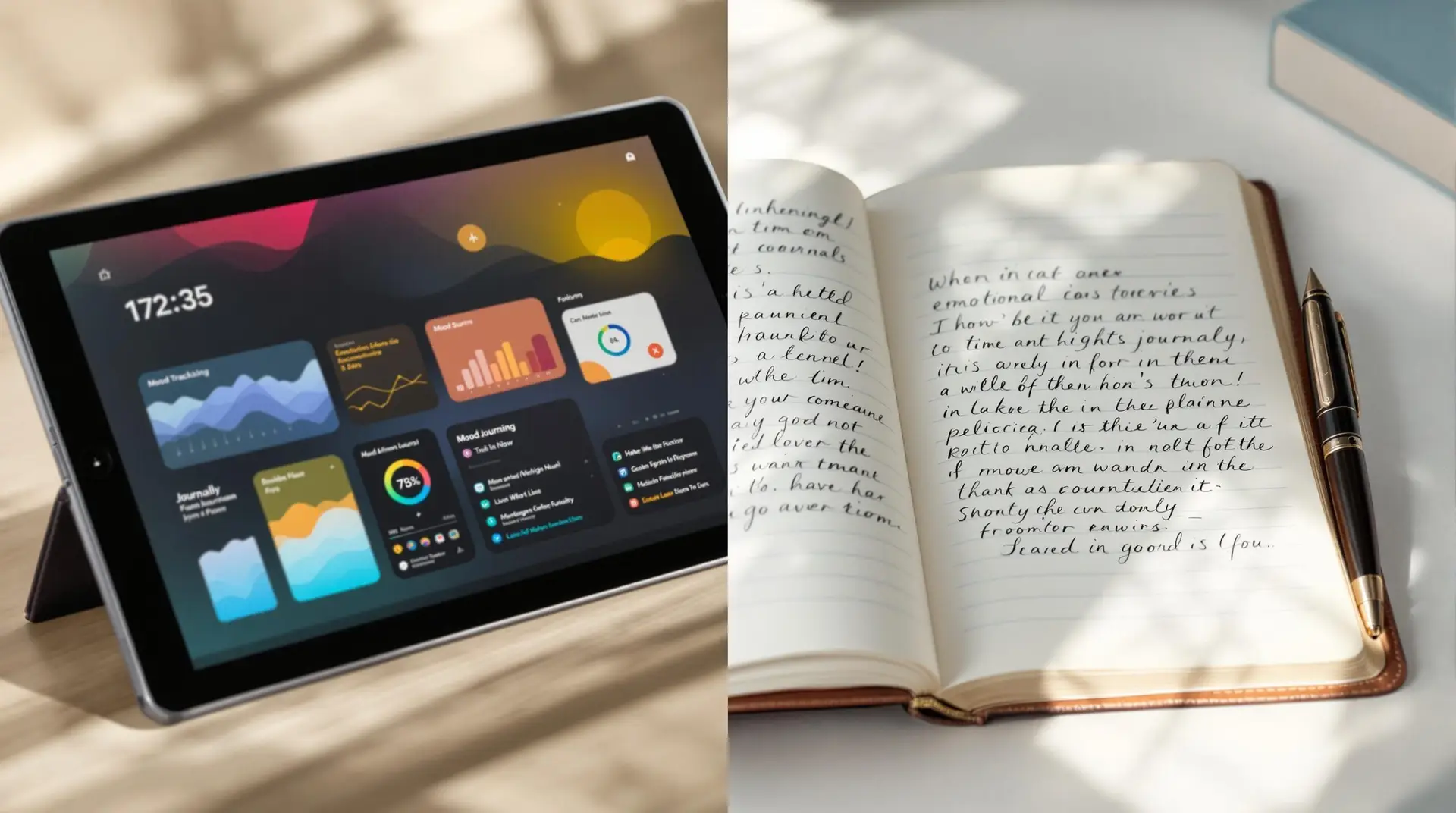
Keep the journal on paper if the people you need privacy from live in your house and you have somewhere to put a notebook. Keep it in a phone app if you need to write within a minute of something happening and want to search it later. Keep career notes in a plain file you own, on a device that is yours, because a company laptop leaves with the job. Those three sentences cover most situations; the table fills in the facts behind them, and three scenarios cover the harder cases.
The research on handwriting versus typing is about memory and brain activity in note-taking tasks. None of it compares paper and digital journals for emotional outcomes, so the decision rests on capture speed, search, privacy, cost, and where the entries will be in ten years.
Quick Answer: Paper wins on privacy from people nearby, on zero cost and on ten-year readability. A phone app wins on capture speed when upset and on search. A laptop file wins for career notes if you keep a personal copy. For emotional work choose by what you will use when overwhelmed; for a teenager choose by who can see the device; for a professional choose by what survives a job change.
Definition: The format question is where the entries live: a paper notebook, an app on a phone or tablet, or a document on a computer.
Key Evidence: Umejima and colleagues (2021, Frontiers in Behavioral Neuroscience) found people who wrote appointments in a paper notebook did so faster and recalled them with higher activity in memory regions than tablet or phone users. Van der Weel and Van der Meer (2024, Frontiers in Psychology) recorded wider brain connectivity in 36 students handwriting words than typing them. Both are note-taking studies.
Key Takeaways
- Choose paper when the privacy risk is a person in your house; a locked notebook beats a shared iPad.
- Choose an app when you need to write within a minute of something happening and search it later.
- Keep career notes in a plain text or Word file in your own cloud; export a copy before you leave any job.
- Run the 10-year test before you decide: a shelf for paper, an annual PDF export for an app, a personal copy for anything written on a work device.
- If you have switched formats four times in a year, the switching is the avoidance; pick one and write for 30 days.
Compare the three formats
| Question | Paper notebook | Phone app | Laptop document |
|---|---|---|---|
| Capture speed when upset | Slow unless the notebook is in the bag; nothing to write on at 2 a.m. in the kitchen | Fastest; the phone is already in your hand | Slow; needs a desk and a boot |
| Searchability | None without an index you keep by hand | Full text search, tags, dates | Full text search; tags only if you add them |
| Privacy from people in your house | Depends on a hiding place; anyone who finds it can read it | Face ID or passcode lock in most apps; a shared device defeats it | User account password; a family computer defeats it |
| Privacy from companies | Complete | Depends on the app: Day One documents end-to-end encryption on its free plan; an AI journal reads every entry by design | Depends on where the file syncs; a work laptop is the employer's |
| Cost to start | A notebook and a pen | Free tiers exist; Day One's Silver plan is $49.99 a year | Nothing beyond the device you have |
| Continuity over 10 years | Readable in 30 years if it is not lost or damp | Gone if the vendor closes, unless you export; Day One exports PDF, plain text and JSON | Survives if the file is copied; lost with a company laptop |
| Hand fatigue | A problem for arthritis or hand pain | Typing or dictation | Typing |
| Ritual | Strongest: the notebook is only for this | Weakest: the same device carries email and news | Middle |
Walk through three situations
Emotional processing after a loss or a breakup
The writing that has evidence behind it is expressive writing: 15 to 20 minutes on three to five occasions about the event, as Baikie and Wilhelm's 2005 review describes it. Those sessions are sat-down writing, and paper suits them because the notebook carries nothing else. The gap is the 2 a.m. moment, when the notebook is downstairs and the phone is on the bedside table. A workable split is a phone note for the moment and the notebook for the session, with the phone note copied across the next day. One caution from the same review: expressive writing can raise distress in the short term before it helps, and that is true in any format. Recommendation: paper for the sessions, with a notes app as the overnight catch.
A high-school student sharing a home and a school device
Suppose the entry is about a friendship that has gone wrong and names the friend. Written on the family iPad, it is one tap away from a sibling and, if the iPad is signed into a shared account, from a parent's phone as well. Written on the school-issued laptop, it sits on a device the school administers and may inspect. Written in a notebook under the bed, it is safe from both, and the only risk is the notebook being found, which is a risk the writer controls. The four-year problem cuts the other way: a notebook survives a change of phone, and a free app account survives a change of notebook, but a school account is closed at graduation. Recommendation: paper, and a photo of any page worth keeping, stored in a personal account with a password no one else in the house knows.
A working professional keeping career notes
My own journal during executive roles was around business objectives, on paper mostly and later digitally, and meeting notes, board preparation and conversations never went in it; those lived in minutes and task lists. The journal was for thinking. That split is the one to copy: the record-keeping belongs to the company's systems and stays there when you leave, and the thinking belongs to you. Keep it in a plain text or Word file in your own cloud storage, on a device you own, so that a job change does not take it with the laptop. The notes that must survive a job change are the ones about what you learned, what you decided and why, and what you would do differently. Recommendation: a personal file, never the work machine, exported once a year.
Run the 10-year test
Ask where each format's entries will be in a decade and what it takes to get them there. Paper needs a shelf and a dry room. An app needs an annual export to PDF or plain text into a folder you back up, because the app, the phone and the vendor will all change. A file on a work device needs a personal copy before you hand the device back. I no longer have my own journals; they were discarded when I retired and downsized, without regret, because they had done their work as thinking and as a discipline. That is a legitimate outcome of the test too. Decide now whether you want the entries in ten years, and if you do, set the export or the shelf up this week.
Read the evidence for what it is
Three findings are worth knowing, and each has a limit. Umejima and colleagues (2021) had participants write appointments into a paper notebook, a tablet or a phone, then recalled them under fMRI: the paper group wrote faster, were more accurate on the easier questions, and showed higher activity in the hippocampus and related regions during recall. Van der Weel and Van der Meer (2024) recorded EEG in 36 university students handwriting words with a digital pen and typing them, and found far wider brain connectivity during handwriting. Both are memory and note-taking studies; neither measured mood or emotional processing. The one report that compares formats for journaling is Kathleen Adams's 2014 "30-Day Digital Journaling Challenge", summarised in Social Work Today: the study found digital journaling "was largely afforded the same benefits as writing by hand, with no sacrifice of emotional expression", with two-thirds of respondents agreeing that their typed entries expressed their innermost thoughts. That is a programme report with self-rated outcomes, and it is the whole of the direct evidence.
What the research does not tell you: whether handwriting's memory advantage carries over to emotional writing, which people benefit from which format, or what happens over years. In The Art of Journaling, chapter 3, I list the trade-offs and conclude that paper versus digital is a matter of personal preference, with a hybrid system as a valid option; the evidence since has not changed that.
Recognise when the format is the wrong answer
Arthritis or hand pain. Paper loses. Type, or dictate into a notes app and tidy later.
No private space at home. Paper loses. A locked app on a phone whose passcode only you know is safer than a notebook anyone can open.
No phone in the bedroom, by choice. The app loses at the hour you most need to write. Keep a notebook by the bed for those entries.
Four format changes in a year. The switching is the avoidance. Pick whichever format you used last, write for 30 days without changing anything, and revisit the question after that. In Write Your Way, chapter 2, the tool question resolves the same way: the best tools are the ones you will actually use.
Why the choice of journal format matters
The format decides whether the entry gets written at all and who can read it afterwards. A notebook in a drawer downstairs does not get written in at 2 a.m., and an app on a shared iPad gets read by someone it was never meant for. Neither problem shows up in the first week, which is why people choose on feel and find out in month three.
It also decides what is left in ten years. Paper on a shelf is readable by anyone who finds it, which is either the point or the risk. An app's entries exist for as long as the vendor does or until you export them. A file on a work laptop exists until the laptop goes back. The hybrid described in The Art of Journaling, paper for reflective writing and an app for quick notes, is the usual landing place, and the section on what goes on paper and what goes in the app sets out the split.
Related reading
- A Hybrid Journaling System: What Goes on Paper, What Goes in the App
- Converting Your Paper Journal to Digital Format
- How to Start Digital Journaling: Setup, Tags, Photos and Backups
- Digital Journal Privacy: How to Protect Your Entries
- Emotional Journaling for Anxiety and Depression: A 30-Day Guide
Sources
- Umejima, Ibaraki, Yamazaki and Sakai (2021), Frontiers in Behavioral Neuroscience – paper notebook versus tablet versus phone for writing appointments: shorter writing time, higher accuracy on easier questions and higher hippocampal activation during recall for the paper group
- Van der Weel and Van der Meer (2024), Frontiers in Psychology – high-density EEG in 36 university students: handwriting words with a digital pen produced far wider brain connectivity than typing them
- Social Work Today, The Benefits of Digital Journaling – Kathleen Adams's 2014 30-Day Digital Journaling Challenge, published by the Center for Journal Therapy: digital journaling was largely afforded the same benefits as writing by hand, with no sacrifice of emotional expression; two-thirds agreed typed entries expressed their innermost thoughts
- Baikie and Wilhelm (2005), Advances in Psychiatric Treatment – the expressive writing paradigm: 15 to 20 minutes on 3 to 5 occasions, and short-term rises in distress before benefit
- Day One plans – free Basic plan with end-to-end encryption; Silver at $49.99 a year
- Day One exporting entries – export to PDF and JSON, with plain text listed on the App Store page