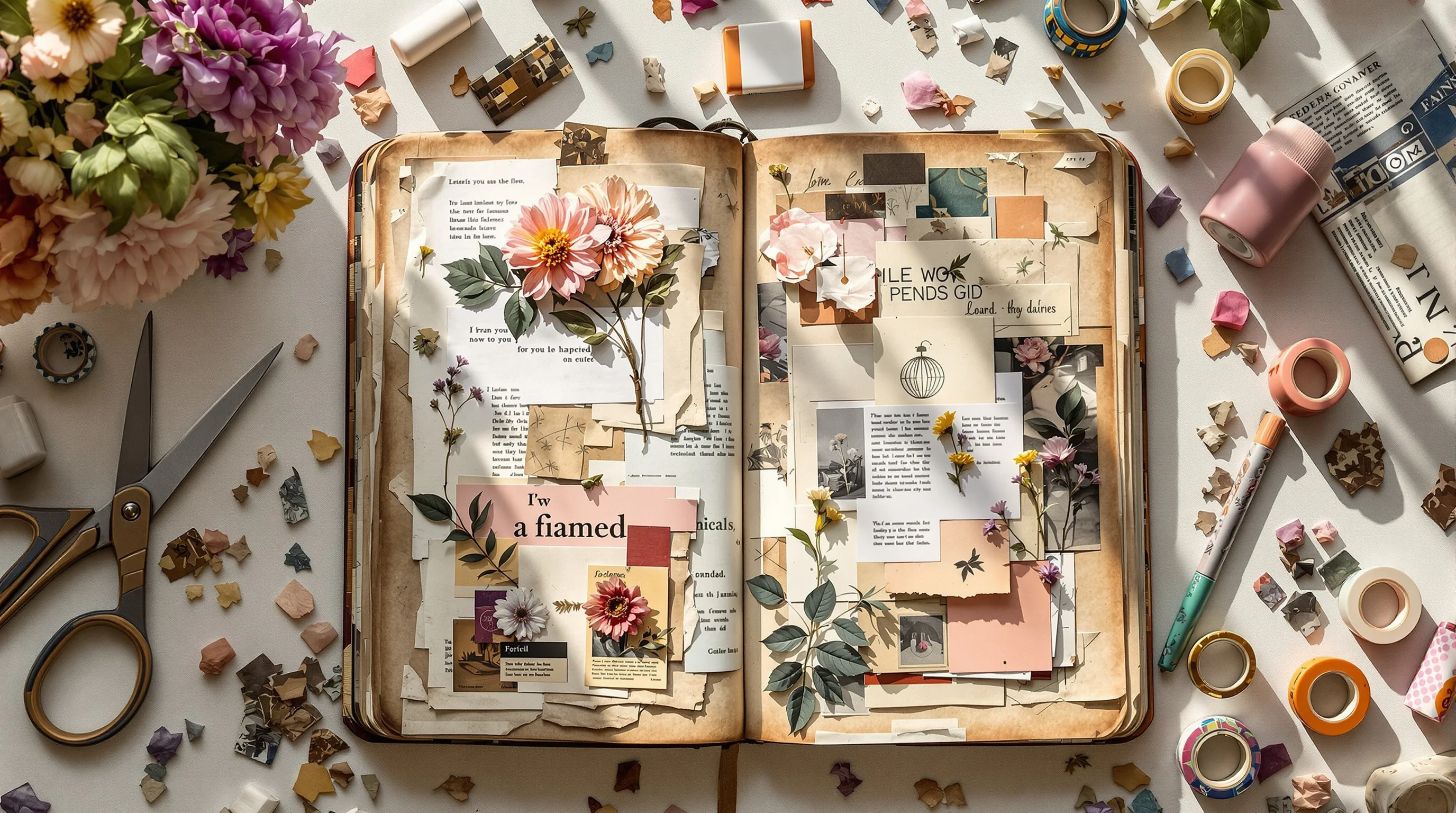
A junk journal is a notebook filled with the paper that passes through your life: receipts, envelopes, tickets, packaging. The techniques that help you process feelings are the ones that make you choose and arrange those scraps before you have decided what they mean. A scrapbooker starts with a plan and buys supplies. A junk journaler tips out a box, picks by feel, glues, and writes one line. That difference is the whole method, and it is why you can start tonight.
In Write Your Way, chapter 6, I teach collage journaling as a dialogue of images and words: tear out what matches your mood, arrange it, write a few lines around it. Junk journaling is that method with the magazines swapped for the contents of your own bin.
Quick Answer: Keep a box for paper you would otherwise throw away. Once a week, tip it out, pick four or five pieces in two minutes without explaining your choices, arrange them on a page without glue, then glue them and write one dated line. A month later, look at what you kept and what stayed in the box. The choosing is the technique; the page is the record.
Definition: Junk journaling is collage journaling done with found and recycled paper, where the page is expected to be rough and the act of choosing matters more than the finish.
Key Evidence: There is no published trial of junk journaling. Psychotherapist Lorraine Collins told Harper's Bazaar UK that any practice that helps us "peel back the layers of our psyche" is valuable, and Kaimal, Ray and Muniz (2016) measured lower cortisol in 39 adults after 45 minutes of art making that included collage.
Key Takeaways
- Start a collection box tonight; a shoebox by the door is enough.
- Limit choosing to two minutes. Longer and you start curating, which is scrapbooking.
- Glue stick for paper, double-sided tape for anything glossy; thermal receipts darken under wet glue.
- If a material is itself the wound (a hospital bracelet, a funeral card), write first and glue later, or leave it out.
Junk journal, scrapbook or art journal
| Practice | Materials | Finish expected | Time per page | What it is for |
|---|---|---|---|---|
| Junk journal | Recycled paper from your own life | Rough; layers may hide each other | 20 to 30 minutes | Noticing what you keep from a week |
| Scrapbook | Bought papers, stickers, printed photos | Tidy, planned, shareable | One to three hours | Preserving an event for others to see |
| Art journal | Paint, ink, pencil, some collage | Expressive, still composed | 30 to 60 minutes | Making an image of a feeling |
Jazmin Kylene, writing for Blavity after a week of it: "There's no pressure to curate an aesthetic; in fact, my junk journal being imperfect is kind of the whole point."
Materials already in the house
You need a notebook whose pages take glue, a glue stick, double-sided tape, scissors and a pen. The middle column is a set of suggestions to test against your own pages.
| Household item | What it tends to carry | Adhesive |
|---|---|---|
| Receipts | Money and time: what a day cost | Glue stick |
| Envelopes | News arriving, wanted or not | Glue stick; keep the flap as a pocket |
| Maps, transit tickets | Being lost, leaving, arriving | Glue stick; tape if laminated |
| Packaging | What you bought to cope, or to celebrate | Double-sided tape |
| Leaves, petals | Where you walked, and the season | Clear tape across the stem |
Five approaches that do the emotional work
Each approach has the same shape: gather, twenty minutes, one line, and a look a month later.
1. The week in scraps
Gather: one week's paper, unsorted. Twenty minutes: pick four or five pieces by feel, arrange, glue. One line: the date and "This week I kept ..." A month later: lay four pages side by side and look at what never reached a page. A month with no receipts, or nothing but receipts, is information.
2. Prompt pages
Gather: the box plus one question written at the top before you choose, such as "A moment I keep replaying." Twenty minutes: choose only pieces that answer it. Empty space is an allowed answer. One line: the question, answered in a sentence after gluing. A month later: check whether the page still agrees with the sentence.
3. Pattern pages
Gather: anything that repeats: the same coffee sleeve, the same route on a ticket. Twenty minutes: one page a month, same layout each time. One line: the month and the thing that appeared most. A month later: note which motif repeats. The written version of this is in how to start mood journaling.
4. The page for what is too big to write
Gather: pieces that stand in for the thing: an empty chair from a catalogue, a closed door, a horizon. Twenty minutes: arrange without gluing for most of the time; glue when the arrangement stops changing. One line: a single noun and the date. A month later: if you can now write a sentence under the noun, write it. If not, come back in another month. This is the page for grief, and it pairs with the written route in trauma journal prompts once words are available.
5. Grounding pages
Gather: textured pieces: corrugated card, tissue, a leaf, the rough side of a paper bag. Twenty minutes: cut, tear and place with attention on the feel of the paper. No subject. One line: the date and one word for how your body feels. A month later: read the words in sequence. This is for the evening when thoughts are running and you want your hands busy.
Your first session in 30 minutes
- Step 0, the week before: put a box by the door and drop paper into it.
- 0 to 3 minutes: clear a surface, open the notebook, put the tools within reach.
- 3 to 5: tip the box out so everything can be seen.
- 5 to 7: choose four or five pieces by feel. Do not explain a choice to yourself.
- 7 to 17: arrange without glue. Overlap, tear, move. Stop when the arrangement stops changing.
- 17 to 25: glue. Press under a heavy book if anything buckles.
- 25 to 28: write one line and the date.
- 28 to 30: close the notebook and put the leftovers back in the box for next week.
An illustrative page
This page is invented. Suppose it is Tuesday after a week of late nights. In two minutes the hand picks four things: a pharmacy receipt, an unopened envelope from the bank, a cinema ticket for a film missed because of a meeting, and a takeaway menu. The receipt goes top left. The envelope goes in the centre, still sealed. The ticket is torn in half and the halves glued a finger's width apart. The menu becomes a strip along the bottom. The line reads: "Tuesday. I kept the ticket for a film I did not see." What the arrangement showed was the sealed envelope in the middle, the one item never opened. The page solved nothing. It put the unopened thing where it could be seen.
What the evidence is and is not
There is no published trial of junk journaling; a PubMed search for the term returns nothing. What exists is a practitioner's view and one adjacent study. Psychotherapist Lorraine Collins, quoted in Harper's Bazaar UK in January 2025, said: "Any practice that helps us peel back the layers of our psyche, promoting emotional healing and self-discovery, is incredibly valuable," and added that she welcomes clients bringing in creative work made outside sessions. Kaimal, Ray and Muniz (2016), in Art Therapy, measured salivary cortisol in 39 healthy adults before and after 45 minutes of art making with collage materials, clay or markers. Cortisol fell significantly, and prior art experience and choice of media made no difference. That is one session, one hormone and a small sample. It says nothing about processing feelings over months, so the larger claim is put carefully here and rests on practitioner accounts.
When this does not work
- You need words to process. For some people collage postpones the sentence they were avoiding. The swap: write the sentence first, then glue around it.
- You start curating. The tell is buying supplies: washi tape, printed ephemera packs. Go back to the box and the two-minute rule.
- The materials are the wound. A hospital bracelet, a funeral order of service. If handling the object sets you back, keep it in the box until it is only paper. Write first, glue after.
Why junk journaling techniques matter
Most journaling advice fails at the first blank page. A box of paper you were going to throw away removes that page: the choosing happens before the thinking, so people who cannot start a written entry can start this one. Four pages side by side show a month at a glance, and what is missing shows as clearly as what is there. The practice earns its 30 minutes a week because it gets a page made, dated and kept, and a kept page can be read back.
Related reading
- Visual journaling for people who cannot draw
- Find your journaling style
- Creative journaling
- How to start journaling when you hate writing
Sources
- Harper's Bazaar UK, "How junk journalling became a mindful ritual for busy women" (January 2025) – the Lorraine Collins quotations and her welcome of clients' creative work made outside sessions
- Blavity, Jazmin Kylene, "I Tried Junk Journaling for One Week" (February 2026) – the first-hand account of a week's practice, the imperfection quotation, and the effect of collecting on attention
- Kaimal, Ray and Muniz (2016), Art Therapy, "Reduction of Cortisol Levels and Participants' Responses Following Art Making" – 39 adults, 45 minutes of art making including collage, significant cortisol reduction, no effect of prior experience or media choice