

Start with three prompts, five minutes, bullet points: what is bugging me today, one win in the last 24 hours, and what would make tomorrow better. Answer them the way you would fill in a log at the end of a shift. When something has gone wrong, switch to a four-line debrief: what happened, what worked, what did not, next action with a date.
The page gives the three starters with a worked entry, the debrief template, five sets of five prompts with a rule for which to open, a weekly review, and what to do when the log stalls.
Quick Answer: Treat the journal as a captain's log. Three starter prompts (what is bugging me, one win in 24 hours, what would make tomorrow better), five minutes on a timer, bullets allowed. After a bad meeting, a missed workout or a lost deal, use the debrief: situation, what worked, what did not, next action with a date. Open the money set on payday, the work set after a meeting you replay in the shower, the relationships set after a conversation you are still arguing in your head, the body set after a missed workout, the focus set when three tasks are open.
Definition: A journal prompt for men, as this page uses the term, is a short, direct question about work, money, relationships, the body or focus, written to be answered in bullets in five minutes.
Key Evidence: Marcus Aurelius's Meditations, per the Internet Encyclopedia of Philosophy, "take the form of a personal notebook" written on campaign. Benjamin Franklin describes in his Autobiography a little book with a page per virtue, seven columns for the days and thirteen lines, marking each fault with a black spot. Both are logs.
Context: I kept a journal through executive roles as GM at OSDN (Slashdot and SourceForge), COO at Automation Anywhere, VP at Oracle and CEO of Syntonetic. It held thinking about business problems. Meeting notes and task lists lived elsewhere.
Key Takeaways
- Three starter prompts, five minutes on a timer, bullets. Three times a week is enough to begin.
- The debrief is four lines and five minutes: situation (1 minute), what worked (1), what did not (1), next action with a date (2).
- Twenty-eight prompts in total. Open one set at a time, chosen by the trigger rule.
- Fifteen minutes on Sunday: read the week's entries, count the next actions that got done, write one goal for the week.
- If entries turn into a to-do list, add one "what is bugging me" line; if you skip three days, write one word.
The three starter prompts
My first journaling prompt came from a teacher at school, "What I learned today ..." as the opening line of an entry, and it is still a good way to start picturing the day; the three below do the same job at work.
- What is the one thing that is really bugging me today?
- What is one win I had in the last 24 hours?
- What would make tomorrow better than today?
An invented entry:
Tue.
Bugging me: the Henderson renewal. Told them a number on Friday, finance says it's wrong. Have to go back.
Win: ran before work. First time in nine days.
Tomorrow better if: call Henderson before 10, before I have time to dread it. Book the run again.
Forty words, three lines, one decision. In Write Your Way, chapter 1, the first objection I put in a character's mouth is the one most men have: "I feel silly doing this. It's like I'm back in middle school, starting with Dear Diary." The entry above is the answer.
The debrief
When something has gone wrong, use four lines with a time budget.
SITUATION (1 min):    what happened, in two lines, no adjectives
WHAT WORKED (1 min):  one thing to keep doing
WHAT DID NOT (1 min): one thing, and the cause if you know it
NEXT ACTION (2 min):  one action, one date, one name if it needs someone else
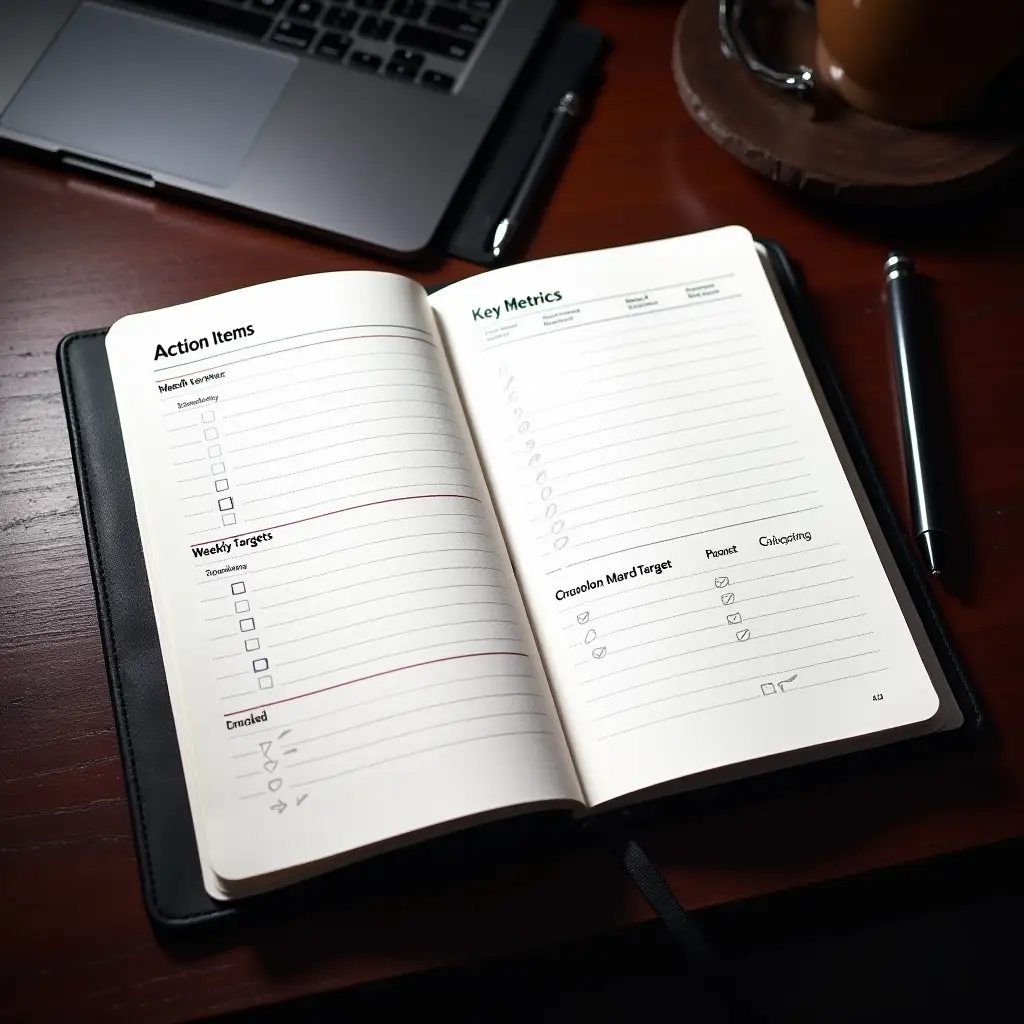
In Write Your Way, chapter 18, I give a longer project debrief (outcome, what went well, what could be improved, lessons learned, ideas for next time); this is the five-minute version. Meeting notes and board preparation never went in it; those were minutes and task lists. What went in, under pressure, were thoughts, options and ideas for solving the problem, and later the solution. The most useful years were at startups, pulled one way by investors and another by the market and the team. It was unpleasant. What kept me writing was that the entries made me understand the problem better. "Go slow to go fast" was my phrase for it: writing it down slowed the thinking and made me work the problem through, so that afterwards I could move quickly.
Five sets, and which one to open
Open one set, answer two or three prompts, stop. The trigger rule: money on payday; work after a meeting you replay in the shower; relationships after a conversation you are still arguing in your head; body after a missed workout; focus when three tasks are open.
Work
- What skill do I need in the next 90 days, and what is the first step?
- What is stopping me asking for the promotion, the raise or the transfer?
- Which decision am I putting off, and what would I tell a colleague in my position?
- What did I replay from today's meeting, and what would I say now?
- Where do I want to be in five years?
Money
- What was the biggest financial win this month?
- Which spending habit do I need to look at honestly?
- What is one investment I am considering, and what is the case against it?
- What would one extra income stream look like, in practice?
- What does the way I handle money say about what I am afraid of?
Relationships
- What is the conversation I am rehearsing, and with whom?
- How am I like my father, and where do I differ on purpose?
- What do I need to get off my chest about my relationship?
- What boundary do I need to set, or hold?
- How can I be a better partner, friend or father this week, in one act?
Body
- What is the current biggest health problem, in plain words?
- How did today's workout, or the missed one, leave me feeling?
- What is one habit I can start tomorrow that costs nothing?
- How is sleep affecting my work this week?
- What is the next fitness milestone, with a date?
Focus
When focus is the problem, change the format first: five-minute timer, bullets only, three items maximum.
- Three thoughts competing for attention right now.
- Focus from 1 to 10 today, and what helped or hurt it.
- The task I am avoiding, and why.
- The biggest open problem, broken into the first three steps.
- One thing to close before I open anything new.

The weekly review
Sunday, fifteen minutes. Read the week's entries. Count the next actions that got done. Write one goal for the coming week. I ran a bigger version at year end, a day or two of retreat, sometimes a walk on the beach, sometimes an overnight train ride, with the goals I had written in front of me, reflecting on the ones I did not reach and the ones I exceeded. Sunday is the small version.
When it stalls
- Entries have become a to-do list. Add one line above the list: what is bugging me. The list can stay.
- You have skipped three days. Write one word for the day and close the book.
- It starts to feel like Dear Diary. Run the debrief template for a week.
Why journal prompts for men matter
The men who avoid journaling picture the diary and decline it. The log was the working tool of an emperor on campaign and of Franklin marking faults in a ruled book, and in my case it was where business problems got thought through when the day gave no room to think. A direct question with a timer on it turns the replay in your head into three lines and a decision, which is all the replay was asking for.
Related reading
- How to Start Journaling When You Hate Writing
- Task Management Journal
- 100 Self-Discovery Journaling Prompts
- 89 Journal Writing Prompts
- All journal prompt guides
Sources
- Internet Encyclopedia of Philosophy, Marcus Aurelius – the Meditations "take the form of a personal notebook" and were probably written on campaign, c. 171 to 175
- Benjamin Franklin, Autobiography (Project Gutenberg) – the little book with a page per virtue, seven columns for the days, thirteen lines, and a black spot for each fault